Skilled Employees Aren't Enough: 4 Components to Turn AI into an Asset
Skilled Employees Aren't Enough: 4 Components to Turn AI into an Asset
In our previous article , we gave your people a ladder. Four skills: Prompt Mastery, Prompt Chaining, Quality Gates, Agentic Readiness, each with a hard measure, each paying for itself before the next rung. If your teams have started climbing, good. Now for the bad news: they’re going to hit a ceiling, and it’s made of questions you haven’t answered.
Picture your best employee, freshly arrived at Level 4. Prompts dialed in. A chained process saving 80% of their time. Quality gates scoring every output. They’re ready to delegate real work to an AI agent. And then they stop, because delegation raises four questions no individual skill can answer:
- Where does the agent find our data, and can it do that without anything leaving the building?
- The agent can follow my process. But where does it learn how we actually do things, the know how that lives in our colleague’s heads?
- When the agent finishes its step and hands work back to me, who tracks that? Where does that task live?
- And when the agent does in ten minutes what used to take me two days, which number on which scorecard changes?
Four questions. Not one of them is about prompting. All of them are the company’s job to answer, and answering them requires four components that very organization has fully built. Only native AI companies have them.
Here’s the uncomfortable truth for the executive reading: training builds climbers. It does not build buildings. If your AI strategy is a training budget and a license count, you’ve funded half a transformation. Your people will reach Level 4, press against the ceiling, and either stall, or start answering these four questions themselves, with public tools and pasted data. You’ve seen how that story ends; it ends with a beautiful deck and outdated numbers in front of a client.
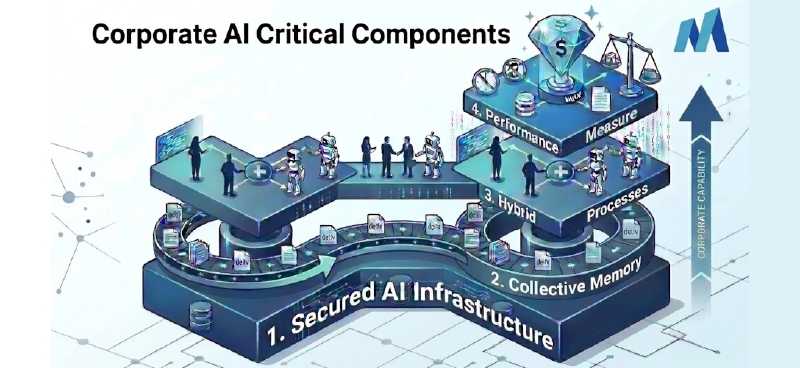
The other half of the transformation is infrastructure. Not software, capability, built once, owned by the company, compounding forever. Four components. Each one answers one question. Each one has a test. And the fourth has nothing to do with AI at all, yet it’s where your entire AI investment either shows up in the numbers or stays invisible to your board.
Component 1 — Secure Infrastructure + Sources of Truth
Answering: “Where does the agent find our data, and can it do that without anything leaving the building?”
Here’s a component that most companies treat as two separate projects, and that’s the first mistake. Secure AI infrastructure and sources of truth are one component. Build them apart, or build them carelessly, and you get one of three failures.
Failure one: the empty vault. You deploy a private, secure AI environment, nothing leaves your infrastructure, no prompts logged by third parties, no client data training someone else’s model. Excellent. And then your people connect it to… nothing. A secure AI with no access to your data is a generic chatbot behind a firewall. It knows the internet and nothing about your business. Your employees try it twice, get generic answers, and go back to the public tools, which is precisely the leak you built the vault to prevent.
Failure two: the leak. You have clean, valuable, well-organized data, pricing, precedents, client history, operational records, and no secure AI to connect it to. That data is one copy-paste away from leaving the building forever. And the copy-paste is already happening, daily, at Level 1, by well-meaning employees trying to save twenty minutes.
Failure three: the confident mess. This one is the most dangerous, because it looks like success. Secure AI: deployed. Data connection: established. And the data itself is a swamp. Contract files in three versions, agreement-latest, agreement_final, agreement_latest-final, and the agent dutifully learns from all of them. A financial system connection that doesn’t segregate entities, so the agent cheerfully mixes Company A’s margins into Company B’s report. Everything works. Nothing is trustworthy. And because the output is fluent and the infrastructure is “secure,” nobody checks, until a client does.
That third failure exposes the hard prerequisite most vendors won’t mention: your data must be clean. Not “cleaned up someday.” Clean, structured, consistent, properly segregated, now. Because AI has a specific, dangerous weakness: it is very bad at managing inconsistencies. Give it two opposing facts, two departments that define “client” differently, a price list that contradicts a contract, three versions of the same agreement, and it doesn’t flag the conflict. It picks one. Essentially at random. A coin flip, delivered with total confidence, inside a document that looks exactly like every other document.
A human assistant hesitates when the numbers don’t match. An AI doesn’t hesitate. That’s why data consistency isn’t housekeeping, it’s the difference between a source of truth and a source of plausible-sounding error. One version per document. One definition per entity. Segregation enforced at the connection, not by the agent’s good judgment, because the agent has none.
The symbiosis, in one line:
A secure AI without sources of truth is an empty vault. Sources of truth without a secure AI are a leak. And a secure AI connected to a mess is a confident liar. You build them together or you build nothing.
This is why Component 1 comes first: it’s the prerequisite for everything above it. Your Level 4 employee can’t delegate a single real task until an agent can reach internal data, safely, and trust what it finds there.
The test: Can an employee delegate one real task to an agent that draws only on your internal sources of truth, with zero data leaving your infrastructure, and without anyone having to double check which version of the file it read? If yes, Component 1 exists. If the answer is “the data isn’t ready” or “legal won’t allow the connection” or “we’d need to verify the output,” you know exactly what to build first.
Component 2 — Collective Memory
Answering: “The agent can follow my process. But where does it learn how we actually do things, the know-how that lives in our colleagues’ heads?”
Almost no company has built this component. Most haven’t even named it. And yet it’s the difference between an AI that follows instructions and an AI that works the way your firm works.
Collective Memory is the accumulated know-how of your organization, externalized from people’s brains into a shared, maintained asset. Not a document repository, every company has one of those, and it’s a graveyard of good intentions nobody visits. This is living memory: captured, structured, and continuously fed.
It does two things nothing else can do.
First, it lets AI reproduce the best-known way of doing things, not just the steps of the process. Here’s the distinction that matters: processes are easy. They’re already written down, flowcharted, and copied into the agent’s instructions. But the real know-how was never in the process. It’s in the notes around the process: which client wants the risk flagged early and which wants it framed as an opportunity; why we never send that report on a Friday; what went wrong in 2019 that made us add step three. Collective Memory holds the right way of doing things beyond following the process, and it’s fed by experience: post-mortems of what failed, debriefs of what worked, the wins customers praised out loud. Once that know-how is captured, an agent doesn’t just execute your process, it executes it with your craft.
Second, it survives departures. Today, when an experienced employee leaves, the know-how stored in their brain walks out the door with them, often straight to a competitor, who now benefits from the decade you paid for. The exit interview captures a laptop, a badge, and a handover document nobody reads. With Collective Memory, a copy of the know-how stays behind. The person leaves; the memory remains; the next hire, and the next agent, starts from decade ten instead of day one.
Both effects depend on one design constraint that cannot be compromised:
Collective Memory must be digestible by both humans and AI.
Write it for humans alone, prose, slide decks, tribal storytelling, and AI can’t use it reliably. Structure it for machines alone, fields, tags, logical sequences, and humans won’t maintain it, because nobody volunteers to feed a database. The memory has to be readable by the junior associate on her first week and parseable by the agent on its first task. That dual readability is what makes genuine human-AI collaboration possible: both parties drawing from the same well, in the same language.
Notice who builds this: the champions from Level 1, the seniors who know where the bodies are buried, the teams running post-mortems. Collective Memory is where their knowledge goes to become permanent. And if you’re a managing partner watching three senior rainmakers approach retirement, this component is not an IT project. It’s succession insurance.
The test: When your next senior person gives notice, can you name exactly what stays behind? If the answer is “their laptop and a handover doc,” you don’t have Collective Memory, you have a slow-motion leak of everything that makes your firm good.
Component 3 — Hybrid Human-AI Processes
Answering: “When the agent finishes its step and hands work back to me, who tracks that? Where does that task live?”
Here’s an asymmetry nobody notices until it burns them: the two directions of handover are not equally reliable.
Human → AI is easy. The human triggers the agent, pastes the brief, clicks run. Humans don’t forget to do this, it’s the fun part, the moment of leverage.
AI → human is where work goes to die. The agent finishes its step. And then… nothing. The completed task sits in a queue nobody is watching. No notification, no owner, no deadline. Three days later someone asks “where’s that analysis?” and the answer is “the AI did it Tuesday.” Multiply that by every handover in every process, and your agentic transformation has quietly become a graveyard of finished work nobody picked up.
The fix is a shared timeline. Humans and AI working on the same process need a single system of record where every task has a state, an owner, human or agent, and a place in time. What that system is matters less than that it exists: a project management tool, a ticketing system, even the order statuses in your ERP. It can span different systems, as long as there’s one coherent trail. The rule is simple: a handover isn’t done when the work is done. It’s done when the next party is notified and the status moves.
This gets serious at the cross-department level. Your critical processes already span departments, sales to delivery to finance. Now they also span species: multiple humans, multiple agents, work flowing back and forth between them. Every step of that has to be mapped and documented, not as a one-time process diagram, but as a living definition of who (or what) does each step, and how the baton passes.
And the mapping matters more with every quarter, because of where this is going: gradually, these hybrid processes will involve more agents and less human execution. Humans stay in the loop at the decision points, that’s the loop from Level 4, execute, gate, fallback, but the number of human-touched steps shrinks as the gates prove themselves. That transition is only governable if you can see it. The tracking system is what lets you add agents to a process deliberately, one step at a time, instead of discovering six months later that nobody knows who approved what.
If you can’t see the handovers, you don’t have a hybrid process. You have a relay race where the baton gets dropped in the dark.
The test: Pick one cross-department process. Right now, today, can you see every task’s status and owner, including the agent-owned steps? Can you answer “where is this?” without sending three messages? If not, your first agent deployment will create more coordination work than it saves.
Component 4 — Value-Based Measurement
Answering: “When the agent does in ten minutes what used to take me two days, which number on which scorecard changes?”
This component looks like it has nothing to do with AI. It’s about KPIs, scorecards, how you evaluate work. And it’s the one that decides whether your entire AI transformation shows up in the company’s numbers, or stays invisible to your board.
Here’s the problem: AI breaks time-based measurement. When a human does the work, hours are a rough proxy for effort. When a hybrid process does the work, whose hours are you counting? The human’s? The agent’s? Do tokens count as effort? The moment a machine takes a step, time stops meaning anything, and worse, it starts lying.
Because here’s what time-based measurement does to AI adoption: it punishes it. The employee who uses AI to do in two hours what used to take ten now looks less busy. The team whose hybrid process cut delivery time by 80% now shows “lower utilization.” If your scorecard measures hours, your best AI adopters look like your worst performers. You have built a system that pays people to compete with the machine, and penalizes the ones who refuse to.
The fix is to climb a measurement ladder, four rungs, each better than the last:
Rung 1: Time-based. Billable hours, utilization, presence. Broken by AI on day one.
Rung 2: Task-based. Count executed activities: tickets closed, analyses run, reports generated. Better, it measures activity instead of presence. But tasks can multiply without meaning anything; a hundred completed tasks can still add up to nothing shipped.
Rung 3: Deliverable-based. Count what ships: widgets, memos, contracts, reports. Better still, it measures completion, not motion. But deliverables can be counted while their worth drifts; ten reports are not ten times the value of one.
Rung 4: Value-based. The only universal measure: value produced, defined once, applicable across every team and the whole organization. Client value, revenue value, risk-reduced value, the yardstick that makes a law firm, a hotel group, and a finance department comparable in one conversation.
Why does value win? Because it’s the only metric that moves correctly when AI acts. Every time an agent takes over a step in a hybrid process, every time AI helps a human deliver faster or better, value produced should rise. Task counts might not move. Hours will definitely fall. Deliverables might stay flat while quality doubles. Only value captures the truth of what changed, consistently, across every function.
And that leads to the uncomfortable consequence: all your scorecards have to be re-evaluated. KPIs, utilization targets, bonus formulas, pricing models, all of it was built for a world where humans did the work and hours meant effort. That world is ending. This re-evaluation is not administrative tidying, it is the mechanism by which three years of AI investment becomes visible at company level. Without it, the transformation can be real, compounding, and completely absent from every number your board reviews.
If your scorecard still measures hours, your AI strategy is paying people to compete with the machine, and punishing the ones who use it.
The test: When an AI takes over one process step next quarter, which number on which scorecard moves? If nobody in your executive committee can answer that in one sentence, your transformation has no dashboard, and no way to prove it exists.
The System: How the Four Interlock
Step back. Four questions, four components, four tests:
| Component | Answers the Level-4 Question | Test |
|---|---|---|
| Secure Infrastructure + Sources of Truth | Where does the agent find our data — safely? | One task delegated to an agent on internal sources, zero leakage, no version-checking |
| Collective Memory | Where does it learn how we actually do things? | Departures leave the know-how behind |
| Hybrid Processes | Who tracks work passing between human and agent? | Every task has a status and owner on one shared timeline |
| Value-Based Measurement | Which number on which scorecard changes? | One scorecard number moves when AI takes a step |
None of these components works alone. They form a chain, and each link feeds the next:
Component 1 gives agents the truth. Secure access to clean data is what lets an agent act at all. Component 2 gives agents the craft. Collective Memory is what lets an agent act the way your firm acts. Truth without craft is generic; craft without truth is folklore. Component 3 lets humans and agents share the work. The shared timeline is what turns one person’s clever agent experiment into a governed, cross-department process. Component 4 proves it was worth it. Value-based measurement is what makes all of it visible, and therefore fundable, expandable, and permanent.
Remove any link and the chain fails at a predictable place: no Component 1, agents invent facts or leak data. No Component 2, agents execute like outsiders. No Component 3, work dies in the handovers. No Component 4, the whole thing dies in the next budget review, unable to prove it ever existed.
A word on sequencing, because the obvious question is “do we build all four at once?” No. Component 1 is the prerequisite, it’s what your Level 4 employees are already waiting for, and nothing above it works without it. But Components 2 and 3 can start small: one team’s post-mortems into memory, one process mapped with its handovers. Momentum beats perfection here too: build the component that unblocks the next real delegation, not the one that looks best in a roadmap.
What This Means for Leaders
Last article ended with a diagnostic you could run by walking the floor: show me your saved prompts, show me your quality gates. This one ends with a harder audit, the kind you run in the executive committee, with the doors closed. Four questions:
- Do we have a secure AI environment connected to clean, consistent sources of truth, or are we running a vault, a leak, or a confident mess?
- If our three most senior people resigned tomorrow, what exactly stays behind? Name it. “Their laptop and a handover doc” is a leak in slow motion.
- In our most critical cross-department process, can we see every task’s status and owner right now, including the steps an agent will soon own, or will the first handover die in the dark?
- When AI takes over one process step next quarter, which number on which scorecard moves?
If the answers are mostly “no,” here’s what that means: your AI strategy is currently individual heroics on corporate licenses. Capable people, climbing the ladder, pressing against a ceiling the company hasn’t built past. Which is, not coincidentally, exactly where the first article found your workforce, one level up, same ceiling.
You can start this quarter. Not with a transformation program, with Component 1 and one honest answer to question 4.
The Whole System
Two articles, one framework. Four individual skills make your people ready to delegate. Four corporate components make your company safe to delegate into.
The skills without the components produce exactly what many organizations have today: frustrated Level 4 talent pressing against a ceiling, quietly exporting company data to public tools because nobody built them a better option. The components without the skills produce the opposite failure: expensive infrastructure, pristine and unused, because nobody trained the workforce to climb to where it matters. You need both halves, and you need them to meet.
When they do, the promise stops being a promise. Agents act on your truth, with your craft, inside governed processes, while humans keep the decisions, and the value shows up in numbers your board actually reviews. That’s the difference between AI as a personal productivity trick and AI as an operational advantage: reliable, daily, and compounding.
Your people can climb the ladder. Your company can build the building. The only remaining question is which one you’re behind on, and now you have the diagnostics for both.
Executive FAQ: Understanding the Corporate Critical AI Components
Q1: What is the “four skills, four components” framework for enterprise AI transformation?
A: The framework, developed by System in Motion across two articles, describes the two halves of any successful AI transformation. The first half is individual. Four skills your people climb: Prompt Mastery, Prompt Chaining, Quality Gates, and Agentic Readiness. Each has a hard measure, each pays for itself before the next rung. The second half is corporate. Four components the company must build for those skilled employees to delegate into safely: Secure Infrastructure + Sources of Truth, Collective Memory, Hybrid Human-AI Processes, and Value-Based Measurement. The thesis: training builds climbers. It does not build buildings. Skills without components produce frustrated talent pressing against a ceiling. Components without skills produce expensive, unused infrastructure. You need both halves to meet.
Q2: What are the four questions a Level 4 employee hits that no individual skill can answer?
A: When an employee reaches Agentic Readiness (Level 4), they stop being able to progress alone because delegation raises four questions only the organization can answer:
- Where does the agent find our data, and can it do that without anything leaving the building?
- The agent can follow my process. But where does it learn how we actually do things — the know-how that lives in our colleagues’ heads?
- When the agent finishes its step and hands work back to me, who tracks that? Where does that task live?
- When the agent does in ten minutes what used to take me two days, which number on which scorecard changes?
Not one of these questions is about prompting. All of them are the company’s job to answer. Each maps to one of the four corporate components.
Q3: Why isn’t AI training enough for enterprise transformation?
A: Because training builds capable individuals, but it does not build the infrastructure those individuals need to delegate into safely. “If your AI strategy is a training budget and a license count, you’ve funded half a transformation.” Your people will reach Level 4, press against the ceiling, and either stall — or start answering the four questions themselves, using public tools with pasted company data. That’s how data leaks happen: not through malice, but through frustrated competence. The other half of the transformation is capability: four components, built once, owned by the company, compounding forever.
Q4: What is Component 1, and what are the three failure modes of building it wrong?
A: Component 1 is Secure Infrastructure + Sources of Truth, treated as a single component, not two separate projects. It answers the Level 4 question: Where does the agent find our data — safely? Build it wrong, and you get one of three failures:
- The empty vault: A secure, private AI environment with no data connections. Employees try it twice, get generic answers, and go back to public tools — the exact leak the vault was built to prevent.
- The leak: Clean, valuable data with no secure AI to connect it to. One copy-paste away from leaving the building forever — and the copy-paste is already happening daily.
- The confident mess: Secure AI deployed, data connected, but the data is a swamp of conflicting versions, inconsistent definitions, and unsegregated entities. The agent produces fluent, confident, wrong answers. Nobody checks because the output looks right.
The line: “A secure AI without sources of truth is an empty vault. Sources of truth without a secure AI are a leak. And a secure AI connected to a mess is a confident liar. You build them together or you build nothing.”
Q5: What is AI’s specific, dangerous weakness with data inconsistency?
A: AI is very bad at managing inconsistencies. Give it two opposing facts, two departments that define “client” differently, a price list that contradicts a contract, or three versions of the same agreement — and it does not flag the conflict. It picks one, essentially at random. A coin flip, delivered with total confidence, inside a document that looks exactly like every other document. A human assistant hesitates when the numbers don’t match. An AI doesn’t hesitate. That’s why data consistency isn’t housekeeping. It’s the difference between a source of truth and a source of plausible-sounding error. One version per document. One definition per entity. Segregation enforced at the connection, not by the agent’s judgment — because the agent has none.
Q6: What is the test for Component 1 (Secure Infrastructure + Sources of Truth)?
A: The test is: Can an employee delegate one real task to an agent that draws only on your internal sources of truth, with zero data leaving your infrastructure, and without anyone having to double-check which version of the file it read? If yes, Component 1 exists. If the answer is “the data isn’t ready” or “legal won’t allow the connection” or “we’d need to verify the output,” you know exactly what to build first.
Q7: What is Component 2 — Collective Memory — and why do most companies lack it?
A: Collective Memory is the accumulated know-how of your organization, externalized from people’s brains into a shared, maintained asset. Not a document repository — those are graveyards of good intentions nobody visits. This is living memory: captured, structured, and continuously fed. It does two things nothing else can. First, it lets AI reproduce the best-known way of doing things, not just the steps of the process — the craft, the exceptions, the lessons from what went wrong in 2019. Second, it survives departures. When an experienced employee leaves, the know-how stored in their brain walks out the door. With Collective Memory, a copy stays behind. The person leaves; the memory remains; the next hire — and the next agent — starts from decade ten instead of day one. Almost no company has built this component. Most haven’t even named it.
Q8: What is the dual-readability requirement for Collective Memory?
A: Collective Memory must be digestible by both humans and AI. This is a hard design constraint that cannot be compromised. Write it for humans alone — prose, slide decks, tribal storytelling — and AI can’t use it reliably. Structure it for machines alone — fields, tags, logical sequences — and humans won’t maintain it, because nobody volunteers to feed a database. The memory has to be readable by the junior associate on her first week and parseable by the agent on its first task. That dual readability is what makes genuine human-AI collaboration possible: both parties drawing from the same well, in the same language.
Q9: What is the test for Component 2 (Collective Memory)?
A: The test is: When your next senior person gives notice, can you name exactly what stays behind? If the answer is “their laptop and a handover doc,” you don’t have Collective Memory. You have a slow-motion leak of everything that makes your firm good. For managing partners watching senior rainmakers approach retirement, this component is not an IT project. It is succession insurance.
Q10: What is Component 3 — Hybrid Human-AI Processes — and what asymmetry does it solve?
A: Component 3 solves the asymmetry nobody notices until it burns them: Human → AI handovers are easy — the fun part, the moment of leverage. AI → Human handovers are where work goes to die. The agent finishes its step. And then nothing. The completed task sits in a queue nobody is watching. No notification, no owner, no deadline. Three days later someone asks “where’s that analysis?” and the answer is “the AI did it Tuesday.” Multiply that by every handover in every process, and your agentic transformation becomes a graveyard of finished work nobody picked up. The fix is a shared timeline — a single system of record where every task has a state, an owner (human or agent), and a place in time. The rule: a handover isn’t done when the work is done. It’s done when the next party is notified and the status moves.
Q11: What is the test for Component 3 (Hybrid Human-AI Processes)?
A: The test is: Pick one cross-department process. Right now, can you see every task’s status and owner, including the agent-owned steps? Can you answer “where is this?” without sending three messages? If not, your first agent deployment will create more coordination work than it saves. The tracking system matters because gradually, hybrid processes will involve more agents and less human execution. Humans stay in the loop at decision points (execute, gate, fallback from Level 4), but the number of human-touched steps shrinks as gates prove themselves. A shared timeline is what lets you add agents deliberately, one step at a time, instead of discovering six months later that nobody knows who approved what.
Q12: What is Component 4 — Value-Based Measurement — and why does AI break time-based metrics?
A: This component looks like it has nothing to do with AI. It is about KPIs, scorecards, and how you evaluate work. And it is the one that decides whether your entire AI transformation shows up in the company’s numbers or stays invisible to your board. AI breaks time-based measurement. When a human does the work, hours are a rough proxy for effort. When a hybrid process does the work, whose hours are you counting? The human’s? The agent’s? Do tokens count as effort? Worse, time-based measurement punishes AI adoption. The employee who uses AI to do in two hours what used to take ten now looks less busy. The team whose hybrid process cut delivery time by 80% now shows “lower utilization.” If your scorecard measures hours, your best AI adopters look like your worst performers. You have built a system that pays people to compete with the machine — and penalizes the ones who refuse to.
Q13: What is the measurement ladder — the four rungs from time-based to value-based?
A: The fix is to climb a measurement ladder of four rungs, each better than the last:
- Rung 1 — Time-based: Billable hours, utilization, presence. Broken by AI on day one.
- Rung 2 — Task-based: Count executed activities — tickets closed, analyses run, reports generated. Better, but tasks can multiply without meaning anything.
- Rung 3 — Deliverable-based: Count what ships — widgets, memos, contracts, reports. Better still, but deliverables can be counted while their worth drifts.
- Rung 4 — Value-based: The only universal measure: value produced, defined once, applicable across every team and the whole organization. Client value, revenue value, risk-reduced value.
Why value wins: it is the only metric that moves correctly when AI acts. Every time an agent takes over a step, every time AI helps a human deliver faster or better, value produced should rise. Task counts might not move. Hours will definitely fall. Deliverables might stay flat while quality doubles. Only value captures the truth of what changed. The consequence: all your scorecards must be re-evaluated — KPIs, utilization targets, bonus formulas, pricing models — because all of them were built for a world where humans did the work and hours meant effort. That world is ending.
Q14: How do the four components interlock, and what happens if one is missing?
A: They form a chain, and each link feeds the next:
- Component 1 gives agents the truth. Secure access to clean data lets an agent act at all.
- Component 2 gives agents the craft. Collective Memory lets an agent act the way your firm acts.
- Component 3 lets humans and agents share the work. The shared timeline turns one person’s clever experiment into a governed, cross-department process.
- Component 4 proves it was worth it. Value-based measurement makes all of it visible, fundable, expandable, and permanent.
Remove any link and the chain fails at a predictable place:
- No Component 1 → agents invent facts or leak data.
- No Component 2 → agents execute like outsiders.
- No Component 3 → work dies in the handovers.
- No Component 4 → the whole thing dies in the next budget review, unable to prove it ever existed.
Component 1 is the prerequisite. Build it first. But Components 2 and 3 can start small: one team’s post-mortems into memory, one process mapped with its handovers. Momentum beats perfection.
Q15: What are the four executive audit questions every leadership team should answer behind closed doors?
A: This is the hardest diagnostic — the kind you run in the executive committee, with the doors closed:
- Do we have a secure AI environment connected to clean, consistent sources of truth — or are we running a vault, a leak, or a confident mess?
- If our three most senior people resigned tomorrow, what exactly stays behind? Name it. “Their laptop and a handover doc” is a leak in slow motion.
- In our most critical cross-department process, can we see every task’s status and owner right now — including the steps an agent will soon own — or will the first handover die in the dark?
- When AI takes over one process step next quarter, which number on which scorecard moves?
If the answers are mostly “no,” your AI strategy is currently individual heroics on corporate licenses. Capable people, climbing the ladder, pressing against a ceiling the company hasn’t built past. You can start this quarter — not with a transformation program, but with Component 1 and one honest answer to question 4.
We are Here to Empower
At System in Motion, we are on a mission to empower as many knowledge workers as possible. To start or continue your GenAI journey.
Let's start and accelerate your digitalization
One step at a time, we can start your AI journey today, by building the foundation of your future performance.
Book a Training