Four Approaches to Enterprise Agentic AI
Your finance team knows which reporting task needs an agent. Your IT team knows which data it may access. The organizational choice is how those two kinds of knowledge meet, and how long the business must wait before it can use the result.
Companies approaching agentic AI face decisions about who builds, which platforms people can use, and who authorizes wider deployment. An agent can carry out assigned work through connected tools, either interactively with a user or with a defined degree of autonomy. Its authority still needs boundaries.
The four approaches below offer a practical way to compare those decisions. They are an editorial framework, rather than an industry-standard classification or a ranking of adoption. Organizations can combine them. The first three draw on published documentation and research; the fourth presents a concept System in Motion is developing.
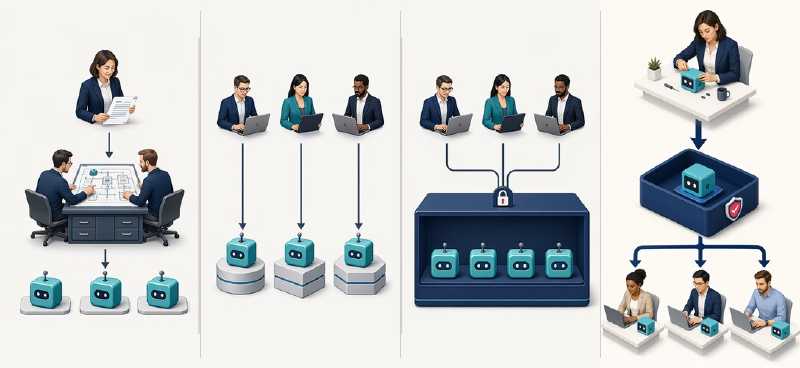
Classic: business requirements, tech delivery
A business user describes a problem to a business analyst, product owner, or project team. That team translates the requirement into a specification. Developers then build, test, integrate, and deploy an agent.
The developers may sit in a central AI team or in individual departments. The defining feature is the handoff: business users specify the work, while a technical team implements the agent.
This approach has a clear foundation in software delivery.
AWS’s guide to agentic AI patterns and workflows
addresses architects, developers, and product leaders. It describes reasoning, orchestration, observability, and control as parts of building agent systems. Those responsibilities explain why a technical delivery team remains valuable, especially when agents act across important business systems.
Central coordination also has an organizational precedent.
Microsoft’s description of a Power Platform Center of Excellence
brings leadership, standards, governance, support, and training together. A CoE can enable business builders too; it does not inherently require every agent to be built centrally.
The strength is accountable engineering.
A technical team can own integrations, manage access, and maintain an agent after its original sponsor changes roles. This can fit complex workflows or actions with substantial business consequences.
The trade-off is the delivery queue. If every adjustment returns to a technical backlog, the company may struggle to capture the small, frequent improvements that business users discover. Translating requirements also creates opportunities to lose context.
For example, a finance analyst might need an agent that checks a report against an approved template. The first specification may capture the template but miss the exceptions the analyst handles each month. Close collaboration can resolve that gap, although it takes delivery capacity.
An executive choosing this model should assign both a business owner and a technical owner. Measure time from request to useful deployment, the effort required for changes, and the quality of completed work. A well-built agent that waits months for a minor revision still creates an adoption problem.
Some companies let business users choose among several AI platforms. Procurement may negotiate enterprise agreements with different providers, and departments can select the option that fits their work.
At the less controlled end, employees simply adopt tools themselves. These are different governance situations, even though both produce a mix of platforms inside the organization.
Employee-led adoption is documented. In the
2024 Microsoft and LinkedIn Work Trend Index
, 78% of surveyed AI users reported bringing their own AI tools to work. The research surveyed 31,000 knowledge workers across 31 markets. This is historical evidence about generative AI use, not a current estimate of autonomous-agent deployment or proof that employers approved those tools.
The mix can also arrive through existing software contracts.
Salesforce describes Agentforce
as a platform for building and deploying agents connected to business data and actions. In ERP,
Microsoft documents Copilot capabilities in Dynamics 365 Business Central
. A company can therefore accumulate AI capabilities through its CRM, ERP, and other applications without explicitly deciding to adopt several separate agent platforms.
The strength is fit and choice
Business users can work with tools suited to their tasks, and a capability embedded in an existing application may be easier to apply to that application’s data and processes.
The trade-off is fragmented governance. Separate providers can mean different permissions, contracts, retention settings, usage charges, and ways to test or monitor behavior. A workflow that crosses platforms also needs an accountable owner.
Multiple platforms can be managed deliberately. An approved portfolio should specify which data each tool may handle, what actions it may perform, and who supports it. Negotiating an enterprise agreement is a useful step, but it does not answer all those questions.
Executives should distinguish approved choice from unmanaged adoption. Maintain an inventory of tools and agents, define common minimum controls, and compare overlapping capabilities before expanding contracts. Choice becomes more useful when users can understand the boundaries of each option.
A third approach standardizes the company on one AI environment. Microsoft Copilot is a recognizable example for organizations already using Microsoft 365. The policy may allow only a narrow set of capabilities, or it may permit substantial development within the Microsoft ecosystem.
The immediate appeal is a common environment for users and administrators. Training can focus on one toolset, and procurement and support have a clearer starting point. The actual scope still depends on how the company configures access.
Licensing is part of that scope.
Microsoft’s Copilot license documentation
describes eligible plans and license assignment. Its
Copilot Studio access documentation
distinguishes subscription capabilities and notes, for example, that a trial permits creation and testing but does not permit publishing. Usage capacity and administrator policy can impose further limits.
The platform is also changing. As of November 2026,
Microsoft documents creating agent skills
from an uploaded package, a blank definition, or an AI-assisted natural-language description. Its
Microsoft Copilot harness overview
describes reusable skills and natural-language-first agent creation, with parts of the experience marked as preview. Building, testing, and evaluating agents may consume Copilot Credits.
These developments already give the comparison more nuance. Business-user creation is becoming possible within Microsoft’s platform; it should not be presented as a capability unique to System in Motion.
The trade-off is dependence on the approved environment’s capabilities and release schedule
If a company restricts itself to a feature set that cannot support a required workflow, that requirement may wait for a vendor release, a policy change, or additional development.
That does not mean every Microsoft customer transforms at the same pace.
Microsoft’s comparison of declarative and custom engine agents
explicitly describes custom orchestration and model choice for custom engine agents. Organizations can extend the environment, with additional implementation and governance responsibilities.
The executive question is therefore how restrictive the standardization policy should be. Define an exception process for valuable workflows that exceed the approved capabilities. Review licenses, available features, and internal permissions together, and evaluate whether standardization is helping teams complete work.
AIM: business users build, governance manages life-cycle
At System in Motion, we are developing an approach in which business users design their own agents inside a governed environment. The aim is to preserve security and performance while giving the people who understand the work more control over its implementation.
This is a concept under development. The lifecycle described here is a proposed design, not a claim that every component is currently available, independently validated, or proven in production.
The distinctive emphasis is the path from personal use to departmental and company use. Agent-assisted creation is one part of that path. Controlled promotion and responsibility after deployment are equally important.
Start with a personal sandbox
Each user would have a personal sandbox where they can describe a task in their preferred language and develop an agent for their own use. Helper agents would assist with design, testing, and refinement.
For example, a finance user could describe the report checks they need, provide approved examples, and review proposed instructions and test results. The user would define the intended behavior, permitted actions, and conditions for escalation. They could then refine the agent based on how it performs on representative cases.
A skill, in this concept, is a reusable capability or set of instructions that an agent can use. An agent is the configured system that performs the work. Either may become a candidate for wider reuse.
The personal sandbox would already operate under platform controls. Its purpose is to limit scope while users experiment. It would not give an agent permission to ignore company rules.
To make that boundary credible, access and action restrictions must be enforced by the platform and connected systems. Instructions alone cannot establish a security guarantee. Users would control the work within those boundaries; their descriptions would not override them.
A user who wants to share an agent or skill with a department would interact with a promotion agent. That agent would prepare and submit a request identifying the version, intended users, required access, and proposed scope of use.
Review would take place in a separate lifecycle-management environment, outside the production runtime. Review agents would analyze the submission against the company’s promotion criteria. Moving review outside the runtime does not, by itself, imply sending business data to an external provider.
The review would need to examine security and compliance, representative quality tests, and resource use. An agent suitable for one person’s task may require different controls when many people rely on it.
Automate eligible decisions and escalate exceptions
If the submission meets the criteria for automatic promotion, the approved version could be redeployed for the requested department or company audience. Automatic promotion would operate under rules authorized by the organization.
If the analysis identifies a concern or a policy requires human approval, the request would go to the appropriate reviewer. Security, compliance, technical, and business specialists would retain authority over the decisions assigned to them.
The wider deployment would need an owner and a record of what was approved. Subsequent changes would need to be assessed against that approval. A complete lifecycle should also cover monitoring, rollback, and retirement; these remain requirements to validate as the concept develops.
Choose the operating model around the work
The proposed division of responsibility gives business users room to build and test within approved limits. Central specialists define those limits and review the cases that need their judgement. This is intended to reduce routine delivery handoffs while preserving oversight of wider deployment.
It also creates obligations: users need training, promotion criteria need to be explicit, and automated reviewers need validation. Performance and security remain outcomes to demonstrate through testing and operation.
| Approach |
Who typically builds? |
Platform policy |
Main trade-off |
| Classic |
Central or departmental technical teams |
Can use one or several platforms |
Engineering ownership versus delivery capacity |
| Multiple platforms |
Users, vendors, and technical teams |
Approved portfolio or unmanaged choice |
Task fit versus consistent oversight |
| Single approved environment |
Users or technical teams, within permitted capabilities |
One environment, potentially extensible |
Standardization versus capability constraints |
| AIM |
Business users assisted by agents |
Governed platform with staged promotion |
Local creation versus the effort to validate controls and lifecycle review |
Start with one workflow and decide who should be able to change it, what it may access, and what must happen before others can use it. Those decisions make platform comparisons concrete.
Discuss your workflow and governance requirements with System in Motion
. We can help define the agent’s scope and implementation needs. The promotion lifecycle described above should be evaluated as a development concept, separately from our existing agent services.
Frequently Asked Questions by Executives
Q1: What is agentic AI in an enterprise context?
A: Agentic AI uses systems that can carry out assigned work through reasoning and connected tools. An enterprise agent may assist a user interactively or operate with defined autonomy. Its permitted data, actions, and escalation rules should be explicit.
Q2: Are these four agentic approaches mutually exclusive?
A: No. A company can use a technical team for complex integrations, approve several tools for specialist work, and standardize other employees on one environment. The four approaches compare operating choices; they are not a universal maturity sequence.
Q3: When does technical-team agent delivery make sense?
A: Technical-team delivery can suit agents with complex integrations or actions that have substantial consequences. Assign a business owner alongside the technical owner so workflow knowledge remains part of testing and maintenance.
Q4: What should we measure in a centrally delivered agent program?
A: Measure time to useful deployment, change effort, and the quality of completed work. Also track support needs and usage costs. These measures help reveal whether delivery capacity is limiting business adoption.
Q5: Does allowing several AI platforms necessarily create shadow AI?
A: No. Several platforms can form an approved, managed portfolio. Shadow AI concerns use outside organizational oversight. Contracts, permitted data, agent inventories, and accountable owners help distinguish managed choice from unmanaged adoption.
Q6: Does every AI feature in a CRM or ERP count as an enterprise agent?
A: No. Embedded AI can include assistance, content generation, recommendations, or agentic actions. Evaluate what the specific feature can do and which permissions it uses before treating it as an autonomous system.
Q7: What is the main benefit of standardizing on one agentic platform?
A: Standardization can simplify training, procurement, and support around a common environment. The benefit depends on whether its permitted capabilities meet the company’s workflows and whether users can obtain the necessary access.
Q8: Can Microsoft Copilot users already create skills?
A: Microsoft’s November 2026 Copilot Studio documentation describes skill creation for agents powered by the Microsoft Copilot harness, including AI-assisted creation. This is a specific documented experience, not evidence that every Copilot license or tenant provides identical access.
Q9: Does a Microsoft-only policy prevent custom agents?
A: No. Microsoft documents declarative agents and custom engine agents, including custom orchestration and model choice. The practical constraint is the organization’s approved scope, entitlements, and capacity to build and govern extensions.
Q10: Is AIM proposed promotion lifecycle available today?
A: This article presents the lifecycle as a concept under development. It does not establish availability or validated performance. Existing agent services and the proposed self-service promotion lifecycle should be assessed separately.
Q11: How would a personal agentic sandbox protect the company?
A: The proposed sandbox would limit a user’s agent to approved data and actions before wider deployment. Protection depends on controls enforced by the platform and connected systems, together with testing and monitoring. A sandbox label alone does not demonstrate security.
Q12: Who would decide whether an agent can be promoted?
A: The organization would define the promotion rules and decision rights. In the concept, review agents assess submissions; eligible requests could be promoted automatically, while exceptions and policy-defined decisions go to human reviewers.
Q13: What changes when an agent moves from personal to department use?
A: Its audience and operational impact expand. Promotion should therefore examine access, quality, resource use, ownership, and support for the proposed scope. Passing personal tests would not automatically establish readiness for departmental use.
Q14: How should we evaluate whether business-user agents creation improves performance?
A: Compare completed-task quality, user effort, response time, and operating cost against the current workflow. Test representative exceptions as well as routine cases. More agents created is an activity measure, not evidence of better business performance.
Q15: What is a useful first step for choosing our agentic approach?
A: Select one workflow, name its business owner, and document permitted data and actions. Decide who can build or change its agent and what wider deployment requires. Use those requirements to compare technical delivery, platform choice, and governed user creation.
We are Here to Empower
At System in Motion, we are on a mission to empower as many knowledge workers as possible.
To start or continue your GenAI journey.