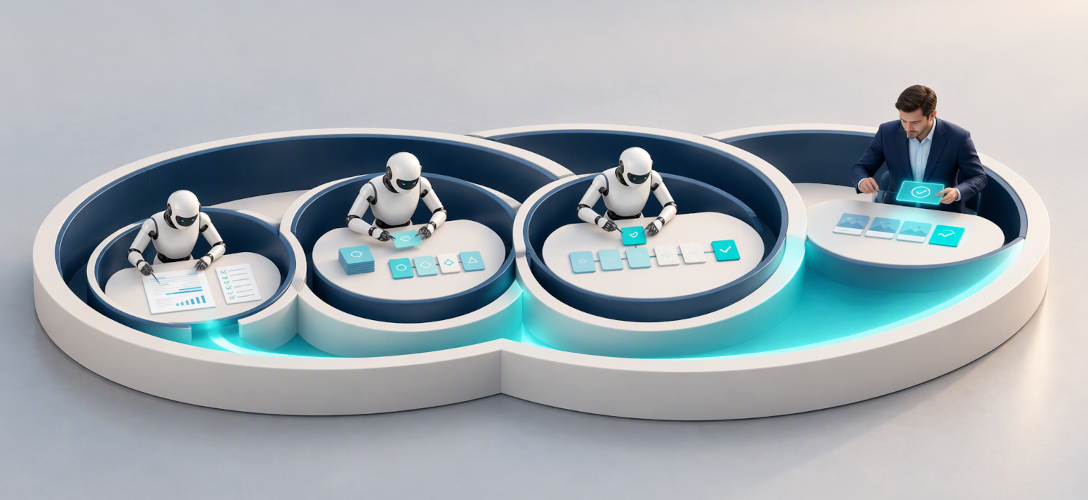
Your Team Has AI. Does It Have AI Skills? Our 4-Level Test
Your Team Has AI. Does It Have AI Skills? Our 4-Level Test
Your company bought the licenses. Copilot for the office suite. Some Cowork credits for the curious. Maybe ChatGPT Enterprise for the innovation team. The rollout email went out, the logins work, and the CIO checked the box.
Six months later, here’s what actually happened: most of your people use AI as a smarter Google. A quick question here, a rephrased email there. Occasional. Shallow. Disposable.
And then there’s the other extreme, the one nobody talks about in the steering committee. An employee generates an entire PowerPoint with Cowork. It looks great. They present it to the client… and can’t answer a single question about what’s inside it. Worse: some of the underlying data was outdated. Fluent output, hollow understanding. That’s not productivity. That’s a liability with good slide design.
These are the two failure modes of unskilled AI use: too little (the smarter-Google user) and too much, too fast (the hollow-deck presenter). Both stem from the same root cause, and it’s not a tool problem. The models are good enough. It’s not an access problem, you paid for the access. It’s a definition problem. Nobody has told your people what “good at AI” actually means. Not the vendor; they sell features. Not IT; they manage licenses. And probably not your training program, if one exists.
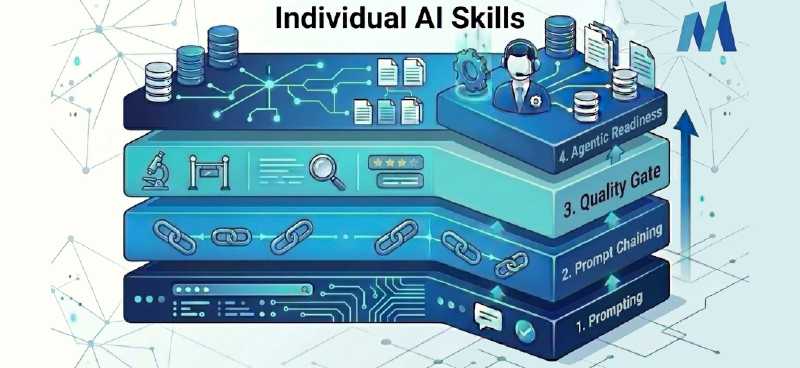
So here is a definition. Four skills, arranged in a ladder. Each one has a hard, measurable test — no vibes, no self-assessment surveys where everyone scores themselves “intermediate.” Each one delivers positive ROI before you climb to the next. And the top of the ladder is where individual productivity turns into delegated, agentic work.
One warning before we start: if your AI training can’t tell you whether an employee is at Level 1 or Level 3, it wasn’t training. It was entertainment.
Why a Ladder, Not a Course
Most AI training fails for a simple reason: it treats “using AI” as one skill. You attend a half-day workshop, see a demo that produces a sonnet in the style of your quarterly report, and leave with the vague sense that you should be doing more with this. More what? Nobody says.
Mastery doesn’t work that way. It never has. You don’t learn to drive by studying the engine; you learn in layers, steering, then traffic, then highway. Each layer unlocks the next, and each layer is independently useful. That’s the structure your people need, for two reasons.
First, because skills come before tools. The market wants you to believe the opposite, that the right platform purchase will close the capability gap. It won’t. We put people before process, and process before tools. An employee who can’t get a reliable answer from a single prompt will not be saved by an agentic platform. They’ll just produce unreliable output at greater speed and scale.
Second, because you shouldn’t wait for the top of the ladder to get paid. Every level in this framework delivers standalone ROI. Level 1 starts returning hours the week it’s learned. Momentum beats perfection: climb one rung, bank the gains, climb the next.
And for the executives reading: here’s the part that should matter most to you. A skill you can’t measure is a skill you can’t manage. Each level below comes with a concrete test: numbers, not adjectives. By the end of this article, you’ll be able to walk any floor of your company and know exactly where your workforce stands.
Skill 1 — Prompting: Get It Right the First Time
Here’s the quiet truth about how most people use AI: they treat the first answer as a rough draft. They prompt, get something 60% right, then spend twenty minutes arguing with the machine, rephrasing, correcting, regenerating, until they either get what they want or give up and do it themselves. That’s not mastery. That’s a negotiation.
Prompt Mastery is the skill of getting usable output from a single prompt — the first time.
And “usable” has a number attached to it:
In 90% of cases, the first prompt returns output that is at least 85% correct.
Not perfect. Not publish-ready. 85% is good enough that the employee’s job shifts from drafting to reviewing. They stop staring at a blank page and start processing, refining, deciding. That’s where the hours come back.
The second measure is about coverage, not quality:
Every user holds a personal or shared library of 5–10 prompts, each one mapped to a frequent task.
The rule of thumb is simple: one frequent daily task = one prompt. Writing client status updates? There’s a prompt. Summarizing meeting notes? There’s a prompt. Drafting the weekly ops report, first-pass contract review, research brief? Prompt, prompt, prompt. If a task happens every week and there’s no prompt for it, that’s a leak in the productivity pipeline.
Notice what we did not say: anything about where these prompts come from. Because it doesn’t matter. Some are designed by department champions who know the work cold. Some are copied from the internet. Some are self-built through trial and error. All valid. We don’t grade the provenance of the prompt; we grade the Tuesday-morning result.
The ROI: This is the momentum rung. Hours back, per person, per week, immediately. No process redesign, no system integration, no six-month roadmap. Just an employee who knows how to provide clear instructions, and has a library of proven asks for the work they actually do.
Skill 2 — Prompt Chaining: From Tasks to Processes
Level 1 changes how an employee handles a task. Level 2 changes how they handle a process.
Real work isn’t one prompt. Preparing a client proposal isn’t “write me a proposal,” it’s research the client’s industry, extract the relevant precedents, draft the structure, write the sections, align the pricing, check the tone. Each of those is a step, some a prompt, some a source of truth. And between them? A human being who reads the output, makes a judgment call, and feeds the right material into the next step.
Prompt Chaining is the skill of running several prompts in sequence, with decisions taken in between.
This is where a dangerous misunderstanding dies. The fantasy sold by a thousand LinkedIn posts is “one mega-prompt that does everything.” It doesn’t work, not reliably, not on work that matters. The professional approach is the opposite: break the process into steps, let AI execute each step, and keep the human at every junction where judgment is required. The machine handles the volume. The person handles the calls.
The measure is deliberately aggressive:
At least one end-to-end process where chaining prompts saves 80% of the overall time.
Why 80% and not 30%? Because anything less means the chain isn’t really working, the employee is still doing the process manually with AI as an occasional assistant. At 80%, the workflow has genuinely flipped: AI does the bulk, the human orchestrates.
And here’s the part nobody expects: quality usually goes up, not down. Why? Because each step is executed consistently, every time, with the same rigor, instead of being rushed at 10pm on a Friday by someone with three other deadlines. The human’s judgment is applied where it matters (the junctions), not diluted across mechanical work (the steps).
The ROI: This is where AI graduates from a personal productivity trick to an operational advantage. One process at 80% time saved is worth more than fifty clever one-off prompts.
Skill 3 — Quality Gates: Define “Good” Before You Delegate
Levels 1 and 2 are about producing output. Level 3 is about something most organizations have never done: deciding, explicitly, what good output is.
A Quality Gate is a different species of prompt. It generates nothing. It evaluates.
You feed it a piece of work, a memo, a proposal, a summary, a contract clause, and it returns a verdict: scores against defined criteria, weighted into a final rating. It doesn’t write the client update; it tells you whether the client update is worth sending.
The technology is the easy part. The hard part is upstream: defining quality. Ask a room of partners “what makes a good client memo?” and you’ll get confident nods and zero shared criteria. Quality in most companies lives in people’s heads as intuition, which means it can’t be taught, can’t be scaled, and can’t be checked. A Quality Gate forces that intuition out of the heads and into the open:
- Multi-dimensional. Real quality is never one thing. A client memo might be scored on accuracy, completeness, tone, and risk exposure, four dimensions, not one vibe.
- Weighted and combined. The criteria feed a formula that produces a single final rating. “It’s probably fine” becomes “4.2 out of 5 against our standard.”
That second shift matters more than it looks. Once quality has a number, three things become possible that weren’t before: juniors can self-check before a senior ever sees their work; standards stop drifting between teams and offices; and, this is the one that unlocks everything that comes next, you can verify work you didn’t do yourself.
Which brings us to the bridge. Levels 1 and 2 produce output faster. Level 3 is what makes that output trustworthy. And trust is the price of admission for delegation: you cannot delegate what you cannot evaluate. Not to a junior hire, and not to an AI agent. The Quality Gate is the skill that turns “the AI wrote it, hope it’s fine” into “the AI wrote it, the gate verified it, I signed it.”
Remember the employee from the introduction, presenting a deck they couldn’t defend? This is the level that prevents it.
The ROI: Fewer review cycles, fewer escalations, fewer near-misses reaching clients. And the foundation, literally the prerequisite, for the final level.
Skill 4 — Agentic Readiness: Delegate the Steps, Keep the Calls
Everything before this level was preparation. This is where it pays off in a new currency: delegation.
Agentic Readiness is the skill of combining your prompts, your chains, and your quality gates with the sources of truth a task depends on — so you can hand parts of a process to an AI agent.
The new move here isn’t a prompt. It’s identification. The employee looks at a process and asks: what does an agent need to know to do this correctly? The pricing database. The precedent library. The brand guidelines. The reservation system. These are sources of truth, the documents, data, and systems that turn a generic agent into one that acts correctly in your context. A user who can name the sources of truth for their process is a user who can delegate. A user who can’t is just hoping.
From choosing ideas to executing them all
Here’s a limitation of Level 2 that most people never notice. In a prompt chain, the human sits at every junction — and at the key steps, they choose. Option A or option B? This angle for the proposal or that one? They pick the most promising path and discard the rest. Not because the other options were bad, but because human bandwidth is finite: pursuing three directions to the end costs three times the time. So we bet on one and move on.
Agents don’t have that constraint. An agent’s bandwidth is dramatically larger than yours.
In agentic mode, you stop betting. The agent carries all the viable ideas to the end, three proposal angles, five subject lines, two contract structures, and the Quality Gate from Level 3 does what it was built to do: score every candidate against your criteria. What lands on the employee’s desk isn’t one untested bet; it’s the winning top one, two or three, already evaluated. The human’s job moves upstream and improves: instead of guessing which idea is best before execution, they choose among proven finalists after it. Same decision rights. Radically better inputs.
The loop that makes delegation safe
And it all runs inside a supervised loop, not on blind faith:
- The agent executes a step, or a whole branch of options.
- Your Quality Gate evaluates the output, automatically, against the criteria you defined.
- Pass? The agent proceeds. Fail? It retries with adjusted input, and if it still can’t clear the gate, the work falls back to the human, flagged with exactly where and why it failed.
This is what “agentic” actually looks like in professional work: not an autonomous machine running your business, but a loop where AI executes, your standards verify, and a human owns every exception. The person stops being the operator of every step and becomes the manager of the process, reviewing finalists, handling exceptions, refining gates, expanding what’s delegated.
Step by Step
And the delegation grows little by little. That’s not caution for its own sake; it’s how trust is earned. You delegate one block of steps. The gates hold. You delegate the next. Each successful loop buys the confidence to hand over more — productivity compounding with every cycle, while the human keeps the decisions that matter.
Notice what just happened at the top of this ladder: the skills stopped being purely individual. Sources of truth are a company asset. Which means the ceiling of personal AI mastery is set by something bigger — your organization’s AI infrastructure. That’s the subject of the next article.
The ROI: The jump from assisted work to delegated work. Levels 1–3 make an employee faster. Level 4 multiplies what one employee can be responsible for.
The Compounding Effect: Every Rung Pays
Step back and look at what these four skills actually are. Not a syllabus. A stacking system.
| Skill | What Changes | Success Measure |
|---|---|---|
| Prompt Mastery | Drafting → reviewing | 90% of first prompts ≥85% correct; 5–10 prompts mapped to daily tasks |
| Prompt Chaining | Tasks → processes | ≥1 end-to-end process at 80% time saved |
| Quality Gates | Output → verified output | Multi-criteria gates rating work against an explicit standard |
| Agentic Readiness | Assisted work → delegated work | Process blocks delegated to agents; gates verify, humans own exceptions |
Two properties of this ladder matter more than any single rung.
First, every level has standalone ROI. Level 1 returns hours the week it’s learned. Level 2 returns a process. Level 3 returns review cycles and near-misses. Level 4 returns leverage. You never have to promise the CFO that value is “coming in phase three of the transformation.” Each skill pays for itself while it’s still being learned, and banks the credibility to climb the next rung.
Second, the gains don’t just add — they compound. Prompt Mastery makes chains possible. Chains reveal where the decisions live. Quality Gates make those decisions explicit and checkable. And gates are what make delegation safe, which is what makes agents useful. Remove any rung and the ones above it collapse: chains without prompt mastery are unreliable, agents without quality gates are uninsurable. Level 1 pays this week. Level 4 pays for years. But you can’t skip rungs.
This is also why the order of your rollout matters more than the size of your budget. Ten employees at Level 2 will out-produce a hundred with licenses and no ladder. The math of AI productivity is not seats times software. It’s skills, stacked, compounding.
What This Means for Leaders
If you’ve read this far as an executive, here’s the uncomfortable part: you now have a diagnostic, and you should probably run it.
Walk your floors, physically or virtually, and ask two questions: Show me your saved prompts. Show me your quality gates. The first tells you who has Level 1. The second tells you who could ever reach Level 4. In many companies, the honest answer is that 90% of the workforce hasn’t cleared Level 1, a few enthusiasts are chaining prompts in isolation, and nobody, literally nobody, has a quality gate.
That’s not a failure of your people. It’s a failure of definition, and it comes with a price: every week, ungoverned employees are either under-using AI (the smarter-Google crowd) or over-trusting it (the hollow-deck presenter from the introduction). Both failure modes are now visible to you. Both are fixable.
The fix has a specific shape, and it’s worth being blunt about what it is not:
- It is not generic “intro to AI” training. A prompt library only works when it maps to the tasks a person actually does, which means prompts for lawyers, chains for operators, gates for reviewers. Function-specific or nothing.
- It is not a tool rollout. Another platform purchase doesn’t move anyone up a rung. Skills do.
- It is not optional champions. At Level 1, champions are the prompt providers, the people who know the work cold and turn that knowledge into reusable prompts for their department. Without them, every employee reinvents the wheel alone.
The organizations that win the next three years won’t be the ones with the most, or the best AI licenses. They’ll be the ones where the average employee sits at Level 2 or 3, with a visible path to 4. That’s a training decision, not a procurement decision. And it’s one you can make this quarter.
The Ladder Is Only Half the Building
Four skills. Four measures. One ladder.
Prompt Mastery turns blank pages into first drafts worth reviewing. Prompt Chaining turns tasks into processes that save 80% of the time. Quality Gates turn “probably fine” into a standard you can verify. Agentic Readiness turns all of it into delegated work, agents executing, gates checking, humans deciding.
Each rung pays for itself. Stacked, they compound. And unlike most transformation programs, you can start tomorrow: pick one team, build their first ten prompts, and let the momentum do what momentum does.
But there’s a ceiling, and you hit it at Level 4. The moment an employee tries to delegate real work to an agent, they run into questions no individual skill can answer: Where does the agent find the pricing database? Who maintains the precedent library? What happens when two departments define “client” differently? Sources of truth, the thing that makes agents act correctly in your context, are not a personal asset. They’re company critical AI components.
Which means individual mastery, however widespread, is only half the equation. Skilled employees need something to plug into. In the next article, we break down the four corporate AI components, starting with secured AI infrastructure and source of truth, that turn a workforce of capable individuals into an organization where AI is not a personal productivity trick, but an operational advantage.
Your people can climb the ladder. The question is whether the building around them is ready.
Executive FAQ - Individual AI Skills Ladder
Q1: Why do most enterprise AI initiatives fail to deliver real productivity gains, even after buying the right tools?
A: The failure is not a tool problem or an access problem. It’s a definition problem. Most companies distribute licenses, send rollout emails, and never define what “good at AI” actually means for their workforce. The result is two failure modes: too little (employees use AI as a smarter Google — occasional, shallow, disposable) and too much, too fast (employees generate fluent output they cannot defend, presenting decks with hollow understanding). Both stem from the same root cause: nobody has told employees what mastery looks like in measurable terms. The fix is a skills framework with concrete, verifiable levels — not a workshop, not a platform, but a ladder where each rung has a standalone ROI and a hard test.
Q2: What are the four levels of AI skill mastery, and how do they stack?
A: The four levels form a progressive ladder where each rung unlocks the next and pays for itself independently:
- Prompt Mastery — Getting usable output from a single prompt, the first time. Measure: 90% of first prompts return ≥85% correct output; each user holds 5–10 prompts mapped to frequent tasks.
- Prompt Chaining — Running several prompts in sequence with human decisions in between. Measure: at least one end-to-end process where chaining saves 80% of the time.
- Quality Gates — Prompts that evaluate rather than generate, scoring output against explicit, multi-dimensional criteria. Measure: gates that produce a single weighted rating against a defined standard.
- Agentic Readiness — Combining prompts, chains, quality gates, and sources of truth so process blocks can be delegated to agents. Measure: delegated blocks running in a supervised loop where gates verify and humans own exceptions.
The gains compound: Level 1 returns hours this week. Level 4 multiplies what one person can be responsible for. But you cannot skip rungs — chains without prompt mastery are unreliable, and agents without quality gates are uninsurable.
Q3: Why can’t we just rely on our AI platform vendor to train our people?
A: Vendors sell features, not skills. Their training teaches you how to use their interface, not how to produce reliable, verifiable work within your specific context. The difference is critical: a vendor will show you how to generate a document; they won’t teach you how to build a prompt library mapped to your actual daily tasks, or how to define quality criteria for your specific industry, or how to chain prompts across your unique workflows. Those are function-specific, company-specific skills that no platform license can deliver. The tool is the enabler. The skill is the advantage. Mistaking platform training for capability building is the most expensive mistake in enterprise AI adoption today.
Q4: How do we measure whether someone is actually skilled at using AI?
A: With numbers, not self-assessment surveys where everyone scores themselves “intermediate.” Each level of the four-skill ladder has a concrete, verifiable test:
- Level 1: Can the employee show you 5–10 saved prompts mapped to their frequent tasks? Can they demonstrate that in 90% of cases, their first prompt returns output that is at least 85% correct?
- Level 2: Can they show you one end-to-end process where chaining prompts saves 80% of the time compared to the previous manual method?
- Level 3: Can they show you a quality gate — a prompt that evaluates work against multi-dimensional, weighted criteria — and explain the standard it encodes?
- Level 4: Can they name the sources of truth their process depends on, and show you a supervised loop where an agent executes, a gate verifies, and exceptions fall back to a human?
A skill you cannot measure is a skill you cannot manage. If your training program cannot tell you whether an employee is at Level 1 or Level 3, it was not training — it was entertainment.
Q5: What is Prompt Mastery, and why should an executive care about it?
A: Prompt Mastery is the skill of getting usable output from a single prompt — the first time. It has two hard measures. First: in 90% of cases, the first prompt returns output that is at least 85% correct. Not perfect, not publish-ready, but good enough that the employee’s job shifts from drafting to reviewing. Second: every user holds a library of 5–10 prompts, each mapped to a frequent task. The rule: one frequent daily task equals one prompt. If a task happens every week and there is no prompt for it, that is a leak in the productivity pipeline.
Executives should care because this is the momentum rung. It returns hours per person, per week, immediately — no process redesign, no system integration, no six-month roadmap. It is the fastest ROI in the entire framework, and it is the prerequisite for everything above it.
Q6: What is Prompt Chaining, and how is it different from writing better prompts?
A: Prompt Chaining is the skill of running several prompts in sequence, with human decisions taken between them. It is not a “mega-prompt that does everything” — that fantasy does not work reliably on work that matters. The professional approach is the opposite: break the process into steps, let AI execute each step, and keep the human at every junction where judgment is required.
The measure is deliberately aggressive: at least one end-to-end process where chaining saves 80% of the overall time. Why 80%? Because anything less means the employee is still doing the process manually with AI as an occasional assistant. At 80%, the workflow has genuinely flipped: AI does the bulk, the human orchestrates. And quality usually goes up, not down, because each step is executed consistently, every time, instead of being rushed at 10pm by someone with three other deadlines.
Q7: What is a Quality Gate, and why is it the most overlooked skill in AI adoption?
A: A Quality Gate is a different species of prompt. It generates nothing — it evaluates. You feed it a piece of work (a memo, a proposal, a contract clause) and it returns a verdict: scores against defined, weighted criteria, combined into a single final rating. The technology is the easy part. The hard part is defining quality — making explicit what most organizations keep as intuition inside people’s heads.
Quality Gates are the most overlooked skill because most organizations have never explicitly defined what “good” means for their own work. Ask a room of partners “what makes a good client memo?” and you get confident nods and zero shared criteria. A Quality Gate forces that definition into the open. Once quality has a number, three things become possible: juniors can self-check before a senior reviews; standards stop drifting between teams; and most critically, you can verify work you did not do yourself.
This is the bridge skill. It is what prevents the “hollow deck” failure mode — an employee presenting fluent output they cannot defend. And it is the literal prerequisite for delegation: you cannot delegate what you cannot evaluate.
Q8: What is Agentic Readiness, and how is it different from just using AI agents?
A: Agentic Readiness is the skill of combining prompts, chains, and quality gates with the sources of truth a task depends on — the pricing database, the precedent library, the brand guidelines, the reservation system. The new move is not a prompt; it is identification. An employee who can name the sources of truth for their process is an employee who can delegate. An employee who cannot is just hoping the agent gets it right.
The critical shift is from choosing to executing all viable options. In Level 2 prompt chaining, a human picks one direction and discards the rest because bandwidth is finite. In agentic mode, the agent carries all viable ideas to completion — three proposal angles, five subject lines, two contract structures — and the Quality Gate scores every candidate. What lands on the employee’s desk is not one untested bet; it is the winning finalists, already evaluated. The human’s job moves upstream: instead of guessing which idea is best before execution, they choose among proven options after it.
And it runs inside a supervised loop: agent executes, gate evaluates — pass means proceed, fail means retry, and if the gate still cannot be cleared, the work falls back to the human, flagged with exactly where and why it failed. This is what “agentic” actually looks like in professional work: not an autonomous machine running your business, but a loop where AI executes, your standards verify, and a human owns every exception.
Q9: Why can’t we skip Level 1 and Level 2 and go straight to agents?
A: Because the ladder is not a curriculum — it is a dependency structure. Each rung builds on the one below it, and removing any rung collapses the ones above:
- Chains without prompt mastery produce unreliable output at greater speed. An employee who cannot get a reliable answer from a single prompt will not be saved by a chain. They will just produce unreliable output faster.
- Agents without quality gates are uninsurable. An agent that executes without verification is a machine that produces fluent, confident, wrong answers at scale. The Quality Gate is the skill that turns “the AI wrote it, hope it’s fine” into “the AI wrote it, the gate verified it, I signed it.”
- Agents without sources of truth are generic and context-blind. An agent that does not know your pricing database, your precedent library, or your brand guidelines will produce output that looks right to an outsider and is wrong for your company.
The market wants you to believe the opposite — that the right platform purchase will close the capability gap. It will not. Skills before tools, always.
Q10: How does the ROI compound across the four levels?
A: The gains do not just add — they compound. Each level pays for itself independently, and the returns multiply as you climb:
| Level | ROI |
|---|---|
| Prompt Mastery | Hours back per person, per week, immediately. No process redesign needed. |
| Prompt Chaining | One process at 80% time saved. Worth more than fifty clever one-off prompts. |
| Quality Gates | Fewer review cycles, fewer escalations, fewer near-misses reaching clients. The foundation for delegation. |
| Agentic Readiness | The jump from assisted work to delegated work. One person can be responsible for what previously required a team. |
Level 1 pays this week. Level 4 pays for years. But you never have to promise the CFO that value is “coming in phase three of the transformation.” Each skill delivers standalone ROI while it is still being learned, and banks the credibility to climb the next rung. The math of AI productivity is not seats times software. It is skills, stacked, compounding.
Q11: What should an executive do on Monday morning to assess their organization’s AI skill level?
A: Walk your floors — physically or virtually — and ask two questions: “Show me your saved prompts” and “Show me your quality gates.”
The first tells you who has Level 1. If they cannot show you 5–10 prompts mapped to their frequent tasks, they have not cleared the first rung. The second tells you who could ever reach Level 4. If nobody in the organization has a quality gate — a prompt that evaluates work against explicit criteria — then nobody can delegate safely, and your organization is capped at Level 2 regardless of how many licenses you bought.
In most companies, the honest answer is: 90% of the workforce has not cleared Level 1, a few enthusiasts are chaining prompts in isolation, and nobody has a quality gate. That is not a failure of your people. It is a failure of definition. But it is fixable — and you now have a diagnostic to run.
Q12: Why does generic “intro to AI” training fail, and what should replace it?
A: Generic AI training fails because it treats “using AI” as one skill. You attend a half-day workshop, see a demo that produces a sonnet in the style of your quarterly report, and leave with the vague sense that you should be doing more — without any clarity on what “more” means or how to measure it.
The replacement is function-specific, skill-ladder training. A prompt library only works when it maps to the tasks a person actually does, which means different prompts for lawyers, different chains for operators, different quality gates for reviewers. The training must be tied to the work, not to the tool. And it must include hard measures of progress — not “I feel more confident” but “I can show you 7 prompts for my weekly tasks, and my first prompt success rate is above 85%.”
If your AI training cannot tell you whether an employee is at Level 1 or Level 3, it was not training. It was entertainment.
Q13: What is the role of “champions” in the AI skills framework?
A: Champions are not optional — they are the critical enablers of Level 1. At Prompt Mastery, champions are the people who know the work cold and turn that knowledge into reusable prompts for their department. They are the source of the 5–10 prompts that every employee needs. Without them, every employee reinvents the wheel alone, and the prompt library never forms.
The framework does not grade the provenance of a prompt — self-built, copied from the internet, or designed by a champion — all are valid. But in practice, the fastest path to organization-wide Level 1 is identifying the domain experts in each function and having them build the first prompt library for their team. The champion’s job is not to be the only skilled person. It is to make everyone else skilled faster.
Q14: What is the ceiling of individual AI skills, and what comes after Level 4?
A: The ceiling is reached at Level 4 when an employee tries to delegate real work to an agent and runs into questions no individual skill can answer: Where does the agent find the pricing database? Who maintains the precedent library? What happens when two departments define “client” differently? Sources of truth — the documents, data, and systems that turn a generic agent into one that acts correctly in your context — are not a personal asset. They are company critical AI components.
This means individual mastery, however widespread, is only half the equation. Skilled employees need something to plug into: secured AI infrastructure, maintained sources of truth, governed data standards, and organizational processes that support delegation. The four corporate AI components — starting with source of truth and secured infrastructure — are what turn a workforce of capable individuals into an organization where AI is not a personal productivity trick, but an operational advantage.
Your people can climb the ladder. The question is whether the building around them is ready.
Q15: What is the single most important thing for an executive to understand about AI skills?
A: The organizations that win the next three years will not be the ones with the most or the best AI licenses. They will be the ones where the average employee sits at Level 2 or 3, with a visible path to Level 4. That is a training decision, not a procurement decision. And it is one you can make this quarter.
The uncomfortable truth: in most companies today, ungoverned employees are either under-using AI (the smarter-Google crowd) or over-trusting it (the hollow-deck presenter). Both failure modes are visible, measurable, and fixable. The fix has a specific shape: function-specific training mapped to a ladder of four measurable skills, each with standalone ROI, each compounding into the next. Not a platform. Not a workshop. A definition of what “good” looks like, with numbers attached.
The cost of not defining it is not neutral. Every week your workforce operates without a skills framework, you are paying the price of both failure modes simultaneously — lost productivity from the under-users and accrued risk from the over-trusters. The question is not whether your people can learn. It is whether you will define what they need to learn.
We are Here to Empower
At System in Motion, we are on a mission to empower as many knowledge workers as possible. To start or continue your GenAI journey.

Let's start and accelerate your digitalization
One step at a time, we can start your AI journey today, by building the foundation of your future performance.
Book a Training