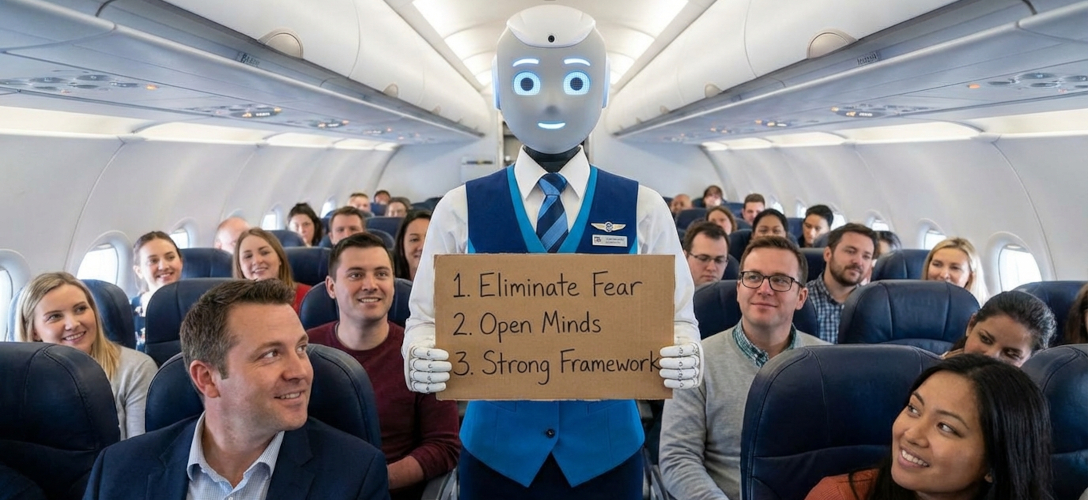
Open Minds: How to Unlock the 1,000 Use Cases You're Not Seeing

Open Minds: How to Unlock the 1,000 Use Cases You're Not Seeing
Open Minds: Second Objective of a Good AI Training
You have to clear the first, crucial hurdle of AI adoption. Your team should not view AI with suspicion or see it as a cryptic threat to their roles. The foundational fear must be replaced by a basic understanding and a cautious curiosity . The guardrails are clear: human-in-the-loop, human accountability. The sandbox has been explored.
But another more insidious barrier often emerges. It’s not fear of the tool, but a failure of imagination.
Teams equipped with powerful new capabilities default to the most obvious, surface-level applications. They use this transformative technology to summarize meeting notes, correct grammar, or perform simple translations. It’s akin to using a state-of-the-art industrial lathe solely to sharpen pencils. The tool is being used, but its profound potential remains locked away, and the return on investment stagnates at a fraction of what’s possible.
This self-limitation, what we call the “Imagination Ceiling,” is the silent killer of AI’s strategic value. It occurs when business users, now willing participants, lack the framework to see their own work through the lens of AI augmentation. They apply AI to the task, not to the workflow. They see the single use case prescribed in a tutorial, but not the hundred micro-opportunities hidden within their daily responsibilities.
The true breakthrough in AI adoption doesn’t happen when people start using it. It happens when they learn to see like it. This is the core mission of the next phase: to systematically open minds, transforming trained users into intuitive innovators. Through our practice-driven methodology, we move beyond teaching a few canned examples. We equip your professionals with a new lens—a mental framework to deconstruct their domain, map AI’s capabilities against real-world processes, and discover the vast landscape of efficiency and insight waiting to be unlocked. This is where cautious adoption evolves into genuine transformation.
From Prescribed Use Cases to Personal Discovery
Traditional training often operates on a model of prescription. It provides a list: “Here are the top ten AI use cases for marketing.” This approach is limiting and fundamentally misaligned with how innovation occurs within established companies. It assumes one size fits all, ignoring the unique processes, legacy systems, and proprietary knowledge that define your business. It gives your team a fish, but it doesn’t teach them how to fish in their own, uniquely stocked pond.
Our methodology is built on the opposite principle: guided discovery. We believe the most powerful, high-impact use cases are not the generic ones; they are the ones your team uncovers for themselves, rooted in the specific friction points and opportunities of their daily work. The goal of our training is not to fill a notebook with examples from other companies, but to activate a participant’s own ability to generate a tailored pipeline of AI applications.
This shift happens through a structured, two-part engine:
The “Job-To-Be-Done” Deconstruction.
We move participants away from their job titles and into their core activities. A “Marketing Director” isn’t just a title; it’s a collection of jobs to be done: conducting audience sentiment analysis, generating campaign concept variants, drafting personalized outreach at scale, synthesizing competitor launch reports, interpreting A/B test results, forecasting channel performance. We lead exercises that break down these responsibilities into discrete, actionable components. This deconstruction is the first critical step in moving from the vague (“improve marketing”) to the specific (“generate five data-backed narrative angles for the Q3 product launch”).
The AI Capability Mapping Exercise.
Once a workflow is decomposed, we introduce a clear menu of core AI capabilities—not as buttons to click, but as conceptual levers to pull. These include: pattern recognition across unstructured data, semantic search within large document sets, multi-document synthesis into a single coherent summary, tone and style adaptation, scenario simulation based on historical data, and automated first-draft generation of structured documents.
The transformative moment, the “Aha!,” occurs when participants begin to map these capabilities onto their deconstructed tasks. They stop thinking, “Can AI write a blog post?” and start thinking:
- “Can AI’s pattern recognition analyze our last 500 customer support tickets to automatically categorize emerging pain points before they trend?”
- “Can multi-document synthesis cross-reference our latest market research, last year’s strategy deck, and this quarter’s sales data to draft the executive summary for our annual plan?”
- “Can scenario simulation model the supply chain impact of three different raw material suppliers based on their recent news, financial health, and geopolitical risk factors?”
This process systematically dismantles the Imagination Ceiling. It replaces a passive search for pre-packaged solutions with an active, generative mindset. Participants realize that the question is no longer “What can AI do?” but “What do I need to do, and which part of that can AI accelerate or enhance?” They transition from looking for use cases to creating them.
“What If…” Leads to “Why Didn’t We Think of That?”
A mind opened to possibility is only powerful if it feels free to explore those possibilities without consequence. This is where the foundational work of eliminating fear pays its highest dividend. The psychological safety we established in the first phase, the clear understanding of human accountability and the controlled sandbox, becomes the launchpad for radical creativity.
In our training environment, we actively cultivate a culture of “What If…” We encourage participants to voice the half-formed, seemingly inefficient, or even audacious ideas they would never propose in a high-stakes business meeting. This is the divergent thinking phase, where quantity and novelty of ideas are valued over immediate practicality.
- “What if we asked the AI to simulate how our top five competitors would respond to our new pricing model, based on their past public statements and pricing history?”
- “What if we could automatically generate a first-draft risk assessment for every new vendor by having the AI analyze their website, recent news, and our contractual templates?”
- “What if we tasked AI with monitoring internal project communications and flagging moments where scope, timeline, or budget assumptions are being discussed without formal documentation?”
These questions are not about immediate implementation. They are about stretching the conceptual boundaries of what AI can be asked to research and prototype. The facilitator’s role here is not to judge an idea’s current feasibility, but to guide the exploration: “That’s an interesting angle. What data would we need to feed the AI to make that simulation credible? Let’s try a simplified version right now and see what it produces.”
This process is liberating. It leverages the core truth that participants are the ultimate decision-makers. The AI is not an oracle delivering final answers; it is the world’s fastest, most patient, and most objective research assistant. It can explore a hundred “what if” scenarios in the time it takes a human to draft one email. It can prototype a dozen report formats, suggest fifty headline variations, or map twenty process flows in minutes.
By decoupling exploration from execution, we remove the final barrier to imagination. Teams learn that they can, and should, use AI to rapidly test hypotheses and brainstorm solutions at near-zero cost. A “bad” idea in this context simply means a five-minute experiment that yielded an unusable output, but which often sparks two better, more refined ideas. This iterative, low-risk experimentation is how they discover the non-obvious, high-value use cases that generic training would never provide. It transforms AI from a task-completion tool into a cognitive partner for strategic thinking.
“AI-First:” The Compounding Return on Curiosity
The ultimate goal of this “Open Minds” phase transcends the training day. It is not merely to generate a list of clever ideas, but to instill a new, operational habit. We aim to equip every participant with what we call the “AI-First” reflex, a default mode of inquiry that becomes embedded in their daily workflow. This habit transforms occasional use into a compounding engine for efficiency and insight.
The AI-First principle is simple: For any new task, your first instinct should be to ask, “Can AI help with this?” You don’t need a complex framework; you need a new starting point.
The operational practice is equally straightforward:
- Attempt Delegation First: When faced with a task—drafting an email, analyzing a dataset, researching a topic, brainstorming names—your first action is to spend 60 seconds instructing an AI. Describe the goal, provide context, and see what it produces.
- Accumulate the Wins: When the result is good, or even partially useful, you save the prompt. This is critical. You are not just saving time on that task; you are building a personal or team library of proven, reusable instructions. This library becomes a strategic asset, compounding in value.
- Fail Fast, Pivot Seamlessly: If the AI’s output is irrelevant or unusable, you’ve lost only a minute. You then seamlessly revert to your standard process. The cost of experimentation is negligible, but the potential upside—discovering a new, repeatable shortcut—is enormous.
This cycle, Attempt, Accumulate, or Abort, creates a powerful compounding effect. Early experiments might save minutes. But as your library of effective prompts grows, you begin to save hours on complex workflows. You stop starting from scratch. You start from a validated, AI-enhanced template. The time savings from yesterday’s experiment fund today’s more ambitious trial.
The cultural ripple effect of this habit is profound. It moves the conversation from “Should we use AI for this big project?” to “Of course we tried AI on this small step, here’s what worked.” It normalizes experimentation and turns every team member into an innovator, contributing their successful prompts to a shared repository of efficiency.
This is the essence of empowering businesses with AI mastery. Mastery is not theoretical knowledge; it is the ingrained discipline of leveraging a tool to its fullest, every single day. It is the shift from viewing AI as a separate application to making it the first step in your process. By adopting an AI-First habit, established companies don’t just find savings; they build a continuously compounding reservoir of time and intellectual capital, turning incremental curiosity into an insurmountable operational advantage.
Conclusion: From Opened Minds to Operational Advantage
The journey from fear to mastery is not a straight line. It is a deliberate progression. First, we eliminate the barrier of apprehension, establishing the safety and guardrails that allow for exploration. Then—and only then—can we tackle the next, more subtle obstacle: the Imagination Ceiling.
As we’ve seen, conquering this ceiling isn’t about more complex software or bigger budgets. It’s about a fundamental shift in approach—from seeking prescribed use cases to cultivating a mindset of guided discovery. It’s the difference between giving your team a map of someone else’s territory and teaching them to survey and chart their own.
Our practice-driven training is engineered to trigger this shift. By deconstructing workflows and mapping AI’s core capabilities against real, daily tasks, we empower your professionals to see the hundreds of micro-opportunities for augmentation hidden within their roles. The psychological safety we build ensures this exploration is energetic and unbounded, turning “what if” into a powerful engine for innovation.
The tangible outcome is the “AI-First” habit—the compounding discipline of making AI the starting point for any task. This reflex, supported by a growing library of proven prompts, transforms isolated experiments into a sustained wave of efficiency gains. It moves AI from a novelty to the new normal, woven into the very fabric of how your company operates.
This is how established businesses move beyond cautious, incremental adoption. This is how you stop just using AI and start evolving with it. You transform your greatest asset—your experienced, knowledgeable people—into architects of their own augmented workflows, unlocking value at a scale that generic tools and generic training can never achieve.
Ready to break through the Imagination Ceiling for your team?
- Discover Our “AI Training Near You”: Move from theory to your own tailored pipeline of high-impact use cases, in your city.
- Continue the Series: In our next post, we’ll address the critical question of prompt efficient: “Strong Framework.”
Open minds don’t just see new tools; they see a new way to work. Let’s build that future, together.
We are Here to Empower
At System in Motion, we are on a mission to empower as many knowledge workers as possible. To start or continue your GenAI journey.

Let's start and accelerate your digitalization
One step at a time, we can start your AI journey today, by building the foundation of your future performance.
Book a Training