
Where Should Your Company Run AI? Public API, Private Cloud or On-Premises
Where Should Your Company Run AI? Public API, Private Cloud or On-Premises
AI Deployment Is a Business Decision, Not an Infrastructure Detail
Your company has identified an AI use case. The model performs well. The team sees the opportunity. Then the initiative reaches the question that determines whether it will ever become part of daily operations:
Where should it run?
Should you use a public AI API to move quickly? Deploy in a private cloud environment for stronger control? Or run a model on your own dedicated infrastructure?
This is not an infrastructure detail to leave until the end of the project. It is a business decision that shapes how fast you can experiment, what data you can use, how predictable your costs will be, and how confidently you can scale.
The deployment model also determines who carries responsibility. With a public API, you gain speed and access to leading capabilities—but must be precise about what data leaves your environment and under what terms. With private cloud, you can strengthen isolation and enterprise controls, while retaining cloud flexibility. With on-premises infrastructure, you gain maximum control over the environment—but also take on the operational responsibility for hardware, capacity, security, and updates.
AI is never only a model. A reliable enterprise solution also requires access controls, a knowledge base, compute capacity, monitoring, guardrails, and clear human accountability. As we explained in AI Jargon Decoded: Infrastructure & Control , these are the components that turn an impressive demonstration into a controlled, scalable business capability.
Do not begin by asking which deployment model is “most secure.”
Begin by asking what your use case requires you to control—and what your organisation is prepared to operate.
The Simplified Selection Table: A Useful Starting Point, Not the Final Decision
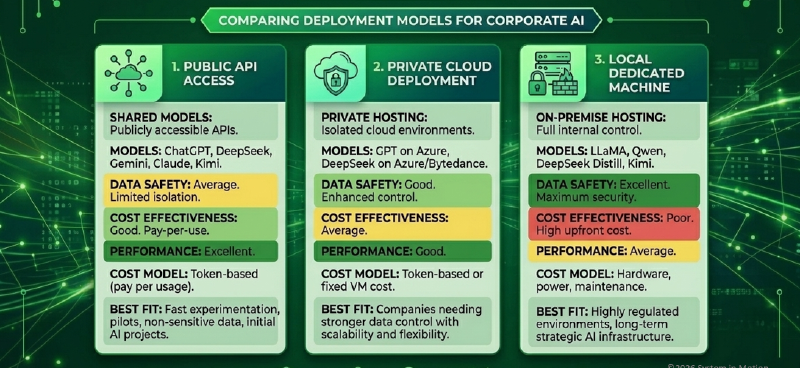
There are three primary ways to deploy corporate AI. Each creates a different balance between speed, control, cost, and operational responsibility.
| Deployment model | Best starting point | Main advantage | Primary trade-off |
|---|---|---|---|
| Public API access | Fast experiments, non-sensitive use cases, early pilots | Speed, access to leading models, low upfront investment | Less direct infrastructure control and variable consumption costs |
| Private cloud deployment | Operational AI connected to internal knowledge and systems | Stronger isolation and enterprise controls without owning all hardware | More architecture, governance, and integration work |
| Local dedicated machine / on-premises | Highly regulated, sensitive, or predictable high-volume workloads | Maximum control over data and infrastructure | High upfront investment and full operational responsibility |
This comparison is useful because it prevents a common mistake: treating every AI use case as though it needs the same deployment model.
A marketing team testing content ideas does not have the same requirements as a legal team working with client-confidential documents. A property operations assistant that accesses guest information does not carry the same risk profile as an internal research tool using publicly available reports. The deployment model should follow the use case—not the other way around.
But the table is only a starting point.
Terms such as secure, private, high-performance, and cost-effective can be misleading when presented as fixed ratings. A public API is not automatically unsafe. A private-cloud deployment is not automatically well governed. An on-premises environment is not automatically secure simply because it sits inside the company.
The outcome depends on the full operating environment: data classification, access permissions, network architecture, encryption, logging, retention policies, guardrails, monitoring, and the people responsible for running it.
For example, on-premises infrastructure gives an organisation direct control over its hardware, data, and network. It also makes that organisation responsible for procurement, installation, maintenance, upgrades, backups, capacity planning, and security. Cloud infrastructure removes much of that operational burden and enables flexible, consumption-based capacity, but requires the company to configure and govern its applications, data, and user access correctly.
Separate the Three Questions That Are Often Mixed Together
When leaders discuss AI deployment, three different decisions are often collapsed into one:
- Where does the model run?
- Where does company data travel and remain?
- Who is responsible for operating the environment?
They are related—but they are not the same.
Where Does the Model Run?
The model may run in a provider’s shared environment through a public API, in an isolated cloud environment, or on infrastructure owned and operated by your company.
This choice affects access to models, speed of deployment, capacity flexibility, and the level of direct infrastructure control. Cloud services allow companies to rent compute capacity as they need it. On-premises or dedicated environments require companies to own—or commit to—more of that capacity themselves.
Where Does Company Data Travel and Stay?
This is the more important question for most business use cases.
Before selecting a deployment model, establish:
- What information will be sent to the AI system?
- Does it include client-confidential, personal, financial, legal, or commercially sensitive data?
- In which country or region will that data be processed?
- Will prompts, documents, and outputs be retained?
- Who can access them?
- Can data be removed, redacted, or anonymised before it reaches the model?
A company may use a public model while limiting the data it shares. It may use a private-cloud environment while still failing to control access properly. Or it may run AI locally but expose sensitive information through weak permissions or poor internal processes.
A simple rule: keep the AI model as close as possible to the data it needs. Every connection between the data source, the AI model, and the user creates another pathway that must be secured, monitored, and governed.
Who Operates the Environment?
Finally, be clear about who carries the operational burden.
With a public AI API, much of the underlying model infrastructure is managed by the provider. With private cloud, responsibility is shared between the cloud provider, your internal teams, and potentially an integration partner. With local dedicated infrastructure, your organisation takes responsibility for hardware, updates, security, capacity, resilience, and support.
More control can be valuable. But control without the ability to operate it becomes a liability.
The right question is not simply, “How much control do we want?”
Who Operates the Environment?
Finally, be clear about who carries the operational burden.
With a public AI API, the provider operates the underlying model infrastructure. Your company still owns the responsibility for what it sends to the model, who can access it, how the application is configured, and how outputs are reviewed.
With private cloud, responsibility is shared between the cloud provider, your internal teams, and potentially an integration partner. The provider operates the underlying cloud platform. Your organisation must still design and govern the environment around it: identity management, private networking, permissions, data flows, monitoring, guardrails, and integration with internal systems.
With local dedicated infrastructure, your company takes responsibility for nearly everything: hardware, GPUs, security updates, capacity, resilience, backups, performance, and support. This can be the right choice for sensitive or high-volume workloads—but only when the organisation has the capability and commitment to operate it properly.
More control can be valuable. But control without the ability to operate it becomes a liability.
This is why deployment is also a decision about your compute strategy. Cloud services let organisations rent capacity as operational expenditure, while private or on-premises infrastructure requires greater upfront investment in the “production machinery” of AI. The right balance depends on data sensitivity, workload predictability, required performance, and the level of operational responsibility your business is prepared to retain.
Public API Access: The Fastest Route to Learning
A public AI API gives your company access to a model hosted and operated by an external provider. Your application sends a request to the model, receives a response, and is usually charged according to usage.
For an organisation starting its AI journey, this is often the fastest way to create momentum. There is no hardware to procure, no GPU cluster to operate, and no long infrastructure project before teams can test whether a use case creates value.
Best suited for
- Early experiments and proof-of-concepts
- Low-risk internal productivity use cases
- Public or non-sensitive information
- Creative ideation and first-draft content
- Workloads with unpredictable or fluctuating demand
- Teams that need access to the latest models quickly
Why companies start here
Public APIs offer three practical advantages:
-
Speed
Teams can move from an idea to a working prototype in days rather than months. -
Access to advanced capabilities
Companies can use leading language, reasoning, image, and multimodal models without building or training them themselves. -
Low upfront investment
Instead of purchasing infrastructure before the value is proven, the company pays for the capacity it consumes. Cloud computing is designed around this on-demand, pay-as-you-go model, enabling teams to scale resources up or down as needed.
The important nuance: public does not mean uncontrolled
A public API should not be treated as a free-for-all tool. The question is not simply whether the model is hosted externally. The question is whether the specific data flow is acceptable for the intended use case.
Before deploying a public API, establish:
- What data will be sent to the model?
- Is the information confidential, personal, regulated, or client-owned?
- Are prompts and outputs retained by the provider?
- Can sensitive information be removed, masked, or anonymised first?
- Which employees and systems are allowed to use the API?
- What human review is required before an output is used or shared?
The company should apply the same security standard to AI data as it does to the systems where that data already lives. If a document is restricted to a small group of authorised employees, an AI workflow using that document should enforce the same restriction—not create an easier route around it.
Cost also needs active management
Public APIs make it easy to begin. They can also make it easy to lose sight of cost.
Most enterprise AI services charge according to tokens: the information sent to the model and the response it generates. Long documents, large Knowledge Bases, extensive conversation histories, and high-volume workflows can increase consumption quickly. Token usage is therefore not a technical footnote; it is a direct operational cost driver.
Private Cloud Deployment: Control Without Owning Every Server
A private-cloud deployment runs AI services in an isolated cloud environment, under stronger organisational control than a standard public API setup. Your company does not share the same open pathway as every other customer. Instead, access is restricted through dedicated tenancy, virtual networks, private endpoints, controlled identities, and enterprise logging.
For companies moving from experimentation to operational AI, this is often the practical middle ground: more control than a public API can offer, without the burden of owning and operating physical hardware.
Best suited for
- Internal knowledge assistants grounded in company documents
- AI agents connected to internal systems and workflows
- Client-facing or compliance-sensitive business processes
- Organisations requiring regional hosting and auditability
- Multi-team deployments moving from pilot to production
- Companies that need cloud scalability with stricter data boundaries
Why companies choose it
-
Stronger isolation
Access to the AI environment can be restricted to your corporate network, your identities, and your approved applications. -
Enterprise integration
Private cloud is better suited to connecting AI with internal knowledge bases, CRM, ERP, and document repositories—the systems where the value of a company Knowledge Base actually lives. -
Cloud flexibility retained
Capacity can still scale with demand, and the underlying infrastructure is maintained by the provider rather than your IT team. -
A credible path to production
For legal, IT, and compliance stakeholders who block public-API pilots, a private cloud deployment often provides the governance posture needed to say “yes.”
The important nuance: private cloud is an architecture, not a product
Buying a “private cloud” does not automatically make an AI system private. The protection comes from deliberate design choices: private networking, identity and access management, encryption, regional data residency, logging, and restricted endpoints.
A concrete example: with Azure Private Link , traffic between your corporate network and cloud services travels over the provider’s private backbone rather than the public internet, and each private endpoint is mapped to a specific resource—so users can only reach that resource, not the wider service. That is what “private” means in practice: a set of explicit, configured controls, not a marketing label.
Responsibility is still shared
Even in a private cloud, the provider secures the underlying platform—physical data centres, hardware, networking—while your company remains responsible for what is built on top: access permissions, data classification, application configuration, guardrails, and monitoring. Guardrails in particular remain your governance layer: content filters, topic boundaries, and data-leakage prevention do not come with the infrastructure; they must be designed into it.
Cost behaviour changes as you scale
Private cloud typically shifts spending from pure pay-per-use toward a blend of fixed and variable costs: reserved compute, storage, networking, plus engineering time to design and maintain the environment. Renting capacity remains an operating expense, but with more committed, predictable components than a pure token-based model.
This is often the right trade-off once usage grows. A pilot with a handful of users belongs on consumption pricing. A company-wide assistant processing thousands of queries a day may be cheaper—and far easier to budget—on dedicated capacity.
Local Dedicated Machine / On-Premises: Maximum Control, Maximum Responsibility
An on-premises deployment runs AI models on hardware your company owns or directly controls—in your own data centre, a secure facility, or a dedicated local environment. No prompts leave your network. No data crosses an external boundary. The entire AI stack, from the GPU to the guardrails, sits inside your perimeter.
This is the deployment model of maximum control. It is also the model of maximum responsibility.
Best suited for
- Highly regulated industries: finance, healthcare, government, defence
- Client-confidential work where data residency is non-negotiable
- Restricted or air-gapped environments with limited external connectivity
- Predictable, high-volume workloads that run continuously
- Low-latency applications sitting close to local systems or equipment
- Long-term strategic AI capabilities the company intends to own
Why companies choose it
-
Complete data sovereignty
Data, models, logs, and outputs never leave the company’s infrastructure. For organisations bound by strict confidentiality obligations, this eliminates an entire category of third-party risk. -
Deep customisation and legacy integration
The environment can be designed around existing systems, specialised hardware, and internal network constraints—rather than forcing workflows to adapt to a provider’s platform. -
Potential long-term economics
For stable, high-volume workloads, owning compute can outperform renting it. This is the classic build-versus-rent decision: on-premises means building and owning your factory, with major upfront capital expenditure for GPU hardware, but better long-term cost control, security, and customisation for high-volume, predictable workloads.
The important nuance: control is not the same as security
This is the most misunderstood aspect of on-premises AI.
Keeping systems local removes certain external risks—but it transfers the full security burden to your organisation. Your teams now own:
- Physical security of the hardware
- Patching and vulnerability management
- Identity and access controls
- Backups, redundancy, and disaster recovery
- Model updates and performance tuning
- Monitoring, logging, and incident response
A poorly maintained on-premises system is not safer than a well-governed cloud deployment. It is simply a risk you own entirely.
The same principle applies inside the AI layer itself. Guardrails—content filters, topic boundaries, data-leakage prevention—remain the non-negotiable governance layer regardless of where the model runs. Local infrastructure protects the perimeter; guardrails protect every interaction within it.
Hardware is the beginning, not the end
GPUs are the specialised production machinery of AI, and compute is the total available capacity of that machinery. Buying the machines is the visible cost. Operating them is the real commitment: power, cooling, replacement cycles, spare capacity, specialist skills, and the discipline to keep utilisation high enough to justify the investment.
This is why on-premises economics only work when demand is predictable and sustained. An underused GPU cluster is an expensive monument to ambition.
How to Choose: Six Executive Questions Before You Select a Deployment Model
By now, the trade-offs are clear: public APIs maximise speed, private cloud balances control with flexibility, and on-premises maximises ownership at the cost of operational responsibility. The remaining question is which one fits your use case.
These six questions will get you to a defensible answer.
1. How Sensitive Is the Data?
Start with data classification, not technology. List what the AI system will actually touch: personal data, client-confidential documents, financial or legal material, trade secrets, regulated records.
The more sensitive the data, the stronger the case for private cloud or on-premises deployment. Low-risk, public, or anonymised information can legitimately run through public APIs—and doing so keeps your experiments fast and inexpensive.
2. Is This an Experiment or a Production Workflow?
Pilots and production systems have different jobs. A pilot exists to prove value quickly; speed and flexibility matter most. A production workflow becomes part of daily operations; it needs reliability, monitoring, access control, and a clear owner.
A common and costly mistake is building production-grade infrastructure for an unproven idea—or, worse, letting a successful pilot drift into daily use without ever hardening it.
3. Is Demand Variable or Predictable?
Workload shape drives economics. Variable, uncertain, or seasonal demand favours consumption-based models where you pay for what you use. Stable, high-volume demand can justify committed or owned capacity.
This is the renting-versus-owning decision applied to AI: cloud services let you rent capacity as an operational expense, while dedicated infrastructure is a capital investment that pays off when workloads are predictable and sustained.
4. What Is the Cost of a Wrong Answer?
Not all AI outputs carry the same risk. A weak marketing headline is an inconvenience. A fabricated figure in a financial report, a hallucinated clause in a contract, or leaked client data is a business event.
For consequential use cases, the deployment decision must come with stronger grounding and control: a Knowledge Base that anchors answers in your verified internal data rather than generic model knowledge, and guardrails that enforce content boundaries and prevent data leakage on every interaction.
5. What Must the AI Integrate With?
An AI that answers generic questions needs little architecture. An AI that retrieves from your document repositories, reads your CRM, or acts inside your operational systems needs deliberate design: identity management, access permissions, logging, and controlled data pathways.
As a rule, the deeper the integration with internal systems, the stronger the case for a deployment model you govern directly. Remember the principle from earlier in this article: keep the AI as close as possible to the data it needs, and give it the same security level as your existing data management.
6. What Can Your Organisation Realistically Operate?
Be frank about internal capability:
- Do you have the skills to run GPU infrastructure, or would you be buying a dependency on external specialists?
- Who monitors cost, performance, and security after launch?
- Who updates models, guardrails, and knowledge sources?
- Who responds when something fails at 2 a.m.?
Ambition is not an operating model. Choosing infrastructure your team cannot run does not create control—it creates a new category of risk that you own entirely.
From Answers to Decision
These six questions rarely point in different directions. If your answers describe sensitive data, production use, predictable demand, high consequence of error, deep integration, and strong internal capability—the case for private cloud or on-premises is clear. If they describe low-risk data, experimental scope, and uncertain demand—start with public APIs and learn fast.
The mistake is not choosing one model over another. The mistake is choosing without asking.
Security, Compliance and Governance: The Human Still Decides
By this point, one thing should be clear: choosing a deployment model is necessary, but it is not sufficient.
A public API with disciplined data handling can be safer than a poorly governed on-premises system. A private cloud with weak access controls is private in name only. Deployment determines where AI runs. Governance determines whether it can be trusted.
Whatever model you choose, the same governance foundation applies:
- Use-case approval — every AI workflow has a defined purpose, owner, and risk assessment before it goes live.
- Data classification — the organisation knows which data the AI may touch, and which it may never see.
- Role-based access — the AI respects the same permissions as the systems it connects to; it never becomes a shortcut around them.
- Audit trails — prompts, retrievals, and outputs are logged, so decisions can be reviewed and incidents investigated.
- Output evaluation — the system is tested against real business scenarios before launch and monitored after it.
- Human review for consequential decisions — anything affecting clients, finances, legal positions, or people passes through accountable human judgment.
Two elements of this foundation deserve special attention, because they are architectural, not procedural.
Guardrails: The Non-Negotiable Layer
Guardrails are the automated rulebook wrapped around your AI: content filters, topic boundaries, bias detection, brand voice enforcement, and data-leakage prevention. They act as a real-time compliance officer for every interaction.
This layer cannot be bolted on after deployment. It must be designed into the system from the start, tested before launch, and updated as the system evolves. Deploying AI without guardrails is the operational equivalent of launching a product without safety testing or legal review. The question to ask any vendor or internal team is not “Do you have guardrails?” but “Show me the framework. How is it tested, and how is it updated?”
Grounding: Where the Answers Come From
Security is not only about keeping data in—it is also about keeping errors out. An AI that generates confident but fabricated figures is a governance failure, even in the most secure environment.
This is why every serious business deployment needs a Knowledge Base: the mechanism that retrieves your verified internal information and grounds every answer in it, transforming the AI from a guessing engine into a reliable conduit of your institutional knowledge. For any use case where accuracy matters—compliance, financial reporting, client-facing decisions—this grounding is not optional.
The Final Layer Is Human
Technology and process can enforce boundaries, filter outputs, and log every action. They cannot carry accountability.
The strategic purpose of this entire governance stack is not to slow AI down—it is to make AI safe to speed up. When guardrails, grounding, and human oversight are in place, automation redirects your people from routine execution to strategic oversight and creative problem-solving, which is where their value actually lives. Governance is not the brake on your AI strategy. It is what makes the strategy safe to accelerate.
Closing: Start With One Use Case, Then Build the Right Foundation
The debate is not cloud versus on-premises. The real question is how to create enough speed to build momentum—without compromising the control your organisation needs.
The companies that succeed with AI are not the ones that picked the theoretically perfect deployment model. They are the ones that picked a defensible one, quickly, and learned from running it.
The path is straightforward:
- Start with a defined business workflow — not a technology preference. A specific task, a specific team, a specific measurable outcome.
- Classify the data that workflow touches. This single step usually determines 80% of the deployment answer.
- Assess the consequence of error. If accuracy matters, ground every answer in a curated Knowledge Base rather than generic model knowledge.
- Estimate demand. Variable and unproven? Rent capacity. Predictable and high-volume? Owning your production machinery becomes a serious option.
- Decide what your team can operate. Infrastructure you cannot run is not control—it is risk you own entirely.
- Then select the deployment model that fits the work — and revisit the decision as the use case matures.
Each deployment model earns its place:
- Public API access wins on speed of learning and access to leading models, for low-risk data and experimental scope.
- Private cloud wins when AI becomes operational—connected to internal knowledge, used by multiple teams, and governed by enterprise policy.
- Local dedicated infrastructure wins when compliance, data sovereignty, or predictable high-volume economics justify owning the environment.
None of these choices removes the governance layer. Whatever runs the model, the system still needs grounding in your verified data, guardrails that enforce your policies on every interaction, and human accountability for consequential decisions.
Not sure which deployment model fits your first production AI use case?
Book a 30-minute AI infrastructure review with our experts. We will assess your data sensitivity, workflow requirements, integration needs, and operating constraints—and identify the most practical path from pilot to production.
Executives Frequently Asked Questions
Q1: What is the most important question an executive should ask before choosing an AI deployment model?
A: Do not start by asking which deployment model is “most secure.” Start by asking what your use case requires you to control—and what your organisation is prepared to operate. The right model depends on data sensitivity, workload maturity, compliance requirements, internal capabilities, and expected usage volume. Security is determined by architecture, configuration, and operational discipline, not by a deployment label.
Q2: What are the three primary AI deployment models for enterprise use?
A: The three models are: (1) Public API access—using a model hosted by an external provider with usage-based pricing; (2) Private cloud deployment—running AI in an isolated cloud environment with stronger network, identity, and access controls; (3) Local dedicated machine / on-premises—running AI on hardware owned and operated by your company. Each offers a different balance of speed, control, cost, and operational responsibility.
Q3: How should an executive decide between public API, private cloud, and on-premises AI?
A: Answer six questions in sequence: (1) How sensitive is the data? (2) Is this an experiment or a production workflow? (3) Is demand variable or predictable? (4) What is the cost of a wrong answer? (5) What must the AI integrate with? (6) What can your organisation realistically operate? Sensitive data, production scope, predictable demand, high consequence of error, deep integration, and strong internal capability point toward private cloud or on-premises. Low-risk data and uncertain demand point toward public APIs.
Q4: What is the single most important principle for data security in AI deployment?
A: Keep the AI model as close as possible to the data it needs. Every connection between the data source, the AI model, and the user creates another pathway that must be secured, monitored, and governed. The AI should have the same level of security as your current data management. If a document is restricted to authorised employees, an AI workflow using that document must enforce the same restriction—not create an easier route around it.
Q5: When should a company choose public API access for AI?
A: Choose public API access when speed of learning matters more than maximum infrastructure control, and when the data and risk profile are appropriate. It is best suited for early experiments, proofs of concept, low-risk internal productivity tools, non-sensitive information, creative ideation, and workloads with uncertain or fluctuating demand. Public APIs provide the fastest time to value, access to leading models, and low upfront investment.
Q6: Is a public AI API safe for enterprise use?
A: A public API is not automatically unsafe, but the question is not simply whether the model is hosted externally. The real question is whether the specific data flow is acceptable for the intended use case. Before deploying, establish: What data is being sent? Is it personal, confidential, regulated, or client-owned? What are the provider’s retention and training policies? Can sensitive information be masked or anonymised first? Who can use the API, and what human review is required?
Q7: When should a company choose private cloud for AI deployment?
A: Choose private cloud when AI is becoming an operational capability—connected to internal data, used by multiple teams, governed by enterprise policies, and expected to scale. It is best suited for internal knowledge assistants, AI agents connected to company systems, sensitive operational workflows, multi-team deployments moving from pilot to production, and organisations that need cloud scalability with stronger data boundaries.
Q8: What does “private cloud” actually mean for AI security?
A: “Private cloud” is an architecture, not a product. A cloud deployment becomes meaningfully private through deliberate design choices: private networking, identity and access management, encryption, regional data residency, logging and audit trails, restricted endpoints, and clear supplier agreements. With Azure Private Link, for example, traffic between your corporate network and cloud services travels over the provider’s private backbone rather than the public internet, and each private endpoint is mapped to a specific resource.
Q9: When should a company choose on-premises AI infrastructure?
A: Choose on-premises when control, compliance, data sovereignty, or predictable high-volume economics clearly outweigh the cost and complexity of owning the AI operating environment—and only when your organisation is genuinely prepared to run it. It is best suited for highly regulated industries, client-confidential work, air-gapped environments, predictable high-volume workloads, and low-latency applications near local systems.
Q10: Is on-premises AI automatically more secure than cloud AI?
A: No. Keeping systems local removes certain external risks, but transfers the full security burden to your organisation. A poorly maintained on-premises system is not safer than a well-governed cloud deployment. Your teams must own physical security, patching, vulnerability management, access controls, backups, disaster recovery, model updates, capacity planning, and monitoring. Control without the ability to operate it becomes a liability.
Q11: How should executives evaluate the cost of different AI deployment models?
A: Compare total cost of ownership, not just upfront or per-token price. Consider infrastructure, model consumption, implementation, integration, maintenance, internal staffing, downtime risk, and the cost of delayed adoption. Cloud services let you rent capacity as operational expenditure, ideal for variable or unproven workloads. Dedicated infrastructure is a capital investment that pays off when workloads are predictable and sustained. Token-based public APIs can appear inexpensive initially but costs grow with volume and complexity.
Q12: What governance is required regardless of which deployment model is chosen?
A: Whatever the deployment model, the same governance foundation applies: use-case approval with defined purpose and risk assessment; data classification; role-based access that respects existing permissions; audit trails for prompts, retrievals, and outputs; output evaluation against real business scenarios; and human review for any consequential decision affecting clients, finances, legal positions, or people.
Q13: What are AI guardrails and why do they matter for deployment?
A: Guardrails are the automated rulebook wrapped around your AI: content filters, topic boundaries, bias detection, brand voice enforcement, and data-leakage prevention. They act as a real-time compliance officer for every interaction. Local infrastructure protects the perimeter; guardrails protect every interaction within it. Deploying powerful AI without guardrails is equivalent to launching a product without safety testing or legal review. The question to ask any vendor is not “Do you have guardrails?” but “Show me the framework. How is it tested and updated?”
Q14: What is the most common mistake executives make when choosing an AI deployment model?
A: Selecting the “safest” option without defining the use case. On-premises may be excessive for a low-risk pilot. A public API may be unsuitable for a confidential client workflow. Another common mistake is comparing only upfront price rather than total cost of ownership. A third is treating cloud as either safe or unsafe—security is determined by architecture, configuration, access control, contractual commitments, and operational discipline, not by a single label.
Q15: What is the first step to building an AI deployment strategy that balances speed with control?
A: Start with a defined business workflow, not a technology preference. Classify the data that workflow touches—this single step usually determines 80% of the deployment answer. Assess the consequence of error. Estimate demand. Decide what your team can operate. Then select the deployment model that fits the work, and revisit the decision as the use case matures. The objective is not to own the most infrastructure. It is to turn AI uncertainty into a reliable, daily competitive advantage.
We are Here to Empower
At System in Motion, we are on a mission to empower as many knowledge workers as possible. To start or continue your GenAI journey.
You should also read
Skilled Employees Aren't Enough: 4 Components to Turn AI into an Asset
Article 26 minutes readLet's start and accelerate your digitalization
One step at a time, we can start your AI journey today, by building the foundation of your future performance.
Book a Training