
Executive Committee's 3-Part AI Action Plan
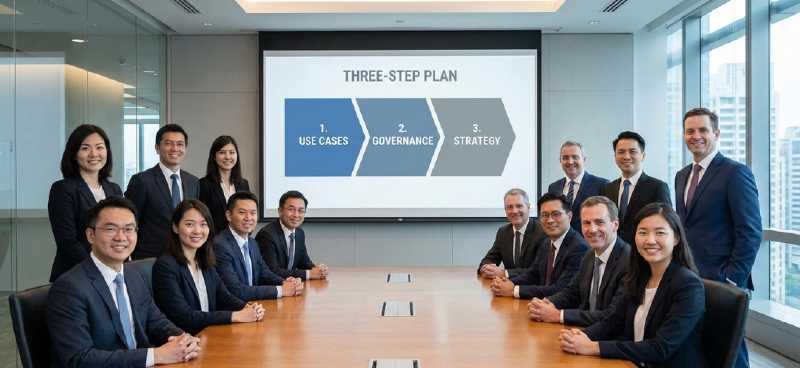
Executive Committee's 3-Part AI Action Plan
From “Should we” to “How, How Fast?”
The conversation in your Executive Committee has shifted. Six months ago, the dominant question was a cautious “Should we?” Today, a more urgent, more complex question has taken its place: “We know we must, so how fast, and how?”
For companies, the window for speculative debate on AI’s importance has closed. The laggards aren’t those who are skeptical; they are those who are stuck, paralyzed by the gap between recognizing AI’s strategic imperative and knowing how to harness it safely, swiftly, and in a way that complements decades of institutional knowledge and legacy systems.
The challenge for today’s Executive Committee is no longer awareness. It is structured, actionable understanding. It’s about moving from abstract potential to a concrete, governed, and department-specific roadmap that aligns with your core business objectives. The risk is no longer in making the wrong bet on AI, but in failing to place a bet at all, ceding ground to competitors who are already moving from planning to execution.
This article cuts through the noise to provide the three critical lenses your leadership team must adopt immediately. We will move beyond theory to a practical framework focused on: demystifying real-world use cases, establishing non-negotiable governance, and building a coherent strategy. This isn’t about adding another item to your agenda; it’s about transforming how you approach one of the most significant operational shifts of our time.
The path forward begins not with another long, theoretical brainstorming session, but with a decisive shift to action. Let’s begin.
Demystifying the “How”: From Concepts to Use Cases
Every executive has seen the headlines: AI will revolutionize everything. Yet, when you look at your own P&L, your established workflows, and your specialized legacy systems, the leap from that grand promise to a tangible, high-impact project can feel insurmountable. This gap between potential and practice is the first and most critical barrier to progress.
The core issue isn’t a lack of information, it’s a lack of embodied understanding. Reading a case study about a retail giant’s AI-powered supply chain is informative, but it doesn’t translate to knowing how AI can optimize your specific procurement process or predict your factory maintenance needs. This abstract knowledge leaves executives asking the wrong first question: “What could AI do for us?” This often leads to either analysis paralysis or the pursuit of flashy, low-value “pet projects” that fail to move the strategic needle.
The right first question is: “What does it feel like to command AI to solve a real business problem?”
True strategic clarity for the C-suite comes not from more reports, but from practiced insight. It comes from the experience of crafting a prompt that generates a targeted marketing campaign, from interrogating an AI’s financial forecast, or from tasking it to draft a compliance checklist. This hands-on interaction reveals both the profound capability and the practical limitations of the technology. You learn its “language,” understand what it takes to get a reliable output, and, most importantly, you start to instinctively map its functionality to the pain points and opportunities within your own domains.
This is why we advocate a “Practice-First” Approach for leadership teams. Imagine condensing months of theoretical exploration into a single, intensive session where 70% of the time is spent not listening, but doing. Executives don’t just learn about AI for marketing; they use it to segment a customer base. They don’t just hear about operational efficiency; they task an AI agent with automating a multi-step approval workflow. This accelerated, immersive experience is transformative. It replaces vague potential with concrete intuition, enabling leaders to rapidly evaluate use cases not as abstract concepts, but as tools they have already learned to wield.
The outcome is a leadership team that speaks from experience. They can move swiftly past “what if” and into decisive conversations about priority, resource allocation, and implementation, because they have already felt the power they are seeking to deploy.
Governing the Power: Framework for Safe AI
Once leadership moves from abstract potential to concrete understanding, a sobering truth emerges: unmanaged AI is an existential liability. The power that drives efficiency also introduces profound risks, data breaches, regulatory penalties, ethical failures, and strategic missteps. For an established company, scaling AI without a command-and-control structure is not an option. Governance is the essential scaffolding that transforms AI from a wildcard into a reliable, corporate-grade asset.
The Executive Committee must own this framework from the outset, establishing four critical pillars:
-
AI-Free Activities: Define the absolute red lines. What core business functions, decisions, or data sets are strictly off-limits to AI? This could include final strategic decisions, sensitive human resources deliberations, proprietary R&D data, or certain customer interactions. Establishing these boundaries is not a limitation, but a declaration of what the company will always control directly, ensuring human judgment and accountability remain at the helm of your most critical operations.
-
Risk & Benefit Registry: Move from vague concerns to quantified analysis. For every proposed AI initiative, leadership must mandate a balanced assessment that catalogues both tangible benefits (e.g., 30% reduction in process time, $X in cost savings) and concrete risks (e.g., data privacy exposure, compliance violation, output inaccuracy). This disciplined, dual-track evaluation forces strategic clarity, prioritizes high-impact, low-risk projects, and ensures AI adoption is driven by business value, not just technological novelty.
-
Governance Model: Establish clear ownership and decision rights. Who approves the use of a new AI tool? Who is accountable for its outputs? What is the ongoing review process? A effective model designates an AI Steering Committee (often comprised of cross-functional leaders) to oversee strategy, while assigning clear operational accountability to business unit heads. This model prevents chaotic, shadow IT adoption and creates clear channels for escalation and audit.
-
AI Tool Vetting Protocol: Implement a rigorous, standardized process for evaluating and onboarding any AI solution. This protocol must cover security audits, vendor due diligence, data integration safeguards, compliance checks, and performance benchmarking. It is your quality control gate, ensuring every tool deployed meets the company’s standards for safety, reliability, and ethical alignment before it ever touches live data or a business process.
The goal is not to create paralyzing bureaucracy, but to build managed velocity. By defining the “AI-Free” zones, quantifying risk versus reward, installing clear governance, and enforcing a strict vetting protocol, the Executive Committee does not slow down AI adoption, it accelerates it with confidence. This framework replaces fear of the unknown with a structured system for managed innovation, turning governance from a perceived barrier into the very enabler of safe, strategic, and scalable transformation.
From Vision to Strategy: Building Your Company’s AI Roadmap
Armed with a practical understanding of AI’s capabilities and a secure governance framework, the Executive Committee faces its decisive task: synthesis. The final challenge is to translate awareness and guardrails into a coherent, actionable plan that delivers tangible, department-level value. This transition from isolated pilots to an integrated corporate strategy is where momentum is often lost, not for lack of ideas, but for lack of a structured, comprehensive starting point.
The traditional approach, gathering leaders for an open-ended brainstorming session, often yields a scattered wish list, disconnected from practical constraints like data readiness or talent availability. It confuses ideation with strategy.
The solution is to leverage AI as a strategic accelerator, not a replacement for executive judgment. Your deep institutional knowledge is irreplaceable. AI’s role is to channel that expertise with unprecedented focus, providing a complete, multi-faceted draft strategy that serves as the catalyst for rapid, informed decision-making.
This is achieved through targeted Executive Strategic Prompts. Imagine commencing your planning session with a consolidated document that provides:
-
A Prioritized List of AI Initiatives for Each Department: A concrete breakdown of high-impact projects for Marketing, Finance, Operations, HR, and Legal, each explicitly tied to current KPIs and business objectives (e.g., “Finance: Implement AI for automated invoice processing and real-time cash flow forecasting to reduce operational costs by 15%”).
-
A List of Data Readiness Initiatives: A clear-eyed assessment of the foundational work required before key AI projects can scale. This identifies critical gaps in data quality, accessibility, and architecture that must be addressed, turning a vague “data problem” into a targeted action plan for IT and data leadership.
-
A Strategic Talent Sourcing Plan: A realistic analysis of the key competencies needed to execute the roadmap. It outlines whether to build (upskill current teams), buy (hire new expertise), or partner (engage specialist firms) for roles like AI Integration Specialists, Data Engineers, and AI Ethics Officers, complete with timeline and budget implications.
-
A Proposal for a Communication & Adoption Plan: A draft framework to ensure AI solutions are embraced, not resisted. This covers stakeholder messaging, change management protocols, and tailored training plans for different departments, designed to maximize utilization and ROI from day one.
The profound power of this AI-generated draft is not its flawless intuition—it is the concrete foundation it provides for executive debate. An AI cannot capture the full nuance of your company’s culture or competitive moat. But by presenting a comprehensive, structured proposal across these four critical pillars, it forces the leadership team to engage with the complete strategic picture. You move from asking “What should we do?” to making decisive choices: “Is this the right priority? Are we prepared on data? Do we have the right talent? How will we ensure adoption?”
This method harnesses the “Power of a Productive Blueprint.” It replaces endless discussion with focused refinement. The committee’s energy is directed toward correcting, validating, and enhancing a tangible plan, compressing months of cyclical planning into weeks of decisive action. The final output is not an AI’s strategy, but your own—sharpened, executable, and owned by the leadership team equipped to see it through.
Critical Bridge: Communication as a Strategic Imperative
No technical strategy, no matter how brilliantly conceived, can succeed without its human counterpart. This is especially true for AI, where the specter of job displacement and opaque “black box” decisions creates a unique and acute layer of organizational anxiety, far surpassing the introduction of any prior technology. A failure to communicate is a direct threat to adoption, morale, and ultimately, your return on investment.
Your communication plan cannot be an afterthought. It must be a core pillar of your AI strategy, running in parallel with every technical initiative. Its objectives are twofold: to demystify and to align.
- Demystify the “Why” and the “How”: Proactively address fear by clearly articulating the strategic intent—AI as a tool to augment human expertise, not replace it. Communicate that the goal is to automate low-value, repetitive tasks (the “what”), freeing your team to focus on high-value judgment, creativity, and strategic work (the “why”). Transparency about governance, ethics, and human oversight is non-negotiable.
- Align the Organization: Frame AI adoption as a collective, company-wide transformation essential for future competitiveness. Tailor messages for different audiences—from the boardroom to the front line—highlighting specific benefits for each role. Celebrate early wins and “augmented” successes to build positive momentum and create internal advocates.
Effective communication turns skepticism into engagement and fear into partnership. It ensures your workforce sees AI not as a looming threat, but as the most powerful tool yet to empower their own roles and secure the company’s future. It is the bridge between a plan on paper and transformation in practice.
The Path to Mastery is Action, Not Deliberation
The journey for the Executive Committee is no longer one of passive observation or cautious study. The competitive landscape has issued its mandate: mastery of AI is no longer a visionary advantage but an operational necessity. The three lenses outlined here—demystifying use cases through practice, governing power with intent, and synthesizing a complete, human-centric strategy—provide the structured framework to move from apprehension to command.
Waiting for the perfect, risk-free moment is the greatest risk of all. The alternative to costly, protracted planning cycles is not recklessness, but accelerated, informed action. It is the approach of engaging with the technology directly to build the critical intuition needed to lead it. It is the discipline of establishing the guardrails that enable speed. It is the wisdom of using AI to draft the blueprint, so your collective expertise can refine it into a master plan.
This is the core of our mission at System in Motion. We empower established businesses to bridge this gap between knowing and doing. Our AI for Executives intensive training is designed precisely for this moment: to transform uncertainty into a clear, actionable agenda. Through dense, practice-driven immersion, we compress months of theoretical exploration into a single, decisive session. Your team will not just learn about AI—they will command it to generate their first governance framework, their strategic hypotheses, and their department-level priorities.
The outcome is a leadership team equipped not with more reports, but with the confidence to ask the right questions and make the key decisions. You will move to your next Executive Committee meeting not with a blank page, but with a populated agenda, a draft governance charter, and a prioritized roadmap to debate and own.
Stop planning to plan. Master the questions, so you can command the answers.
Ready to transform your leadership’s understanding of AI from theoretical to tactical?
Contact us for a call to present the AI for Executive Training
Frequent Asked Questions
Q1: What is the single most critical shift in mindset an Executive Committee must make regarding AI? A: The strategic shift is from asking “Should we?” to asking “How, and how fast?” The window for speculative debate is closed. The risk is no longer a wrong bet, but failing to place a bet at all, ceding ground to competitors who are already moving from planning to execution.
Q2: Why does the “Practice-First Approach” for leadership teams solve the problem of AI adoption paralysis? A: It replaces abstract knowledge with embodied understanding. Instead of reading reports, executives spend 70% of a session doing—crafting prompts, interrogating outputs, and tasking AI agents. This builds concrete intuition, enabling them to rapidly evaluate use cases, prioritize resources, and make decisive implementation choices from experience, not theory.
Q3: What are the four non-negotiable pillars of an AI governance framework that an Executive Committee must own? A: The four pillars are: 1) AI-Free Activities (defining what is strictly off-limits to maintain human control); 2) Risk & Benefit Registry (quantifying both value and risk per initiative); 3) Governance Model (establishing clear ownership, decision rights, and an AI Steering Committee); and 4) AI Tool Vetting Protocol (a standardized process for security, compliance, and performance benchmarking).
Q4: How does an effective governance framework accelerate, rather than slow, AI adoption? A: It creates “managed velocity.” By defining red lines, quantifying risk, and installing clear ownership, the framework replaces fear of the unknown with a structured system for safe innovation. It allows leadership to move fast with confidence, turning governance from a bureaucratic barrier into the enabler of scalable transformation.
Q5: What is the primary failing of the traditional “open-ended brainstorming” approach to creating an AI strategy? A: It yields a scattered, abstract wish list disconnected from practical constraints like data readiness, talent availability, or existing IT infrastructure. It confuses unstructured ideation with a coherent, executable strategy, leading to analysis paralysis.
Q6: According to the article, what is the most effective “Executive Strategic Prompt” to start a strategy session? A: The prompt should generate a consolidated document providing: 1) a prioritized list of department-specific AI initiatives tied to KPIs; 2) a list of required data readiness initiatives; 3) a strategic talent sourcing plan (build, buy, or partner); and 4) a draft communication and adoption plan.
Q7: How does an AI-generated strategic draft turn “analysis paralysis” into decisive action? A: It provides a concrete, structured “productive blueprint” for executive debate. Instead of starting from a blank page, the leadership team’s energy is focused on correcting, validating, and enhancing a tangible plan. This compresses months of cyclical planning into weeks of focused refinement.
Q8: Why must communication be a “strategic imperative” and not an afterthought in an AI rollout? A: AI generates a unique level of organizational anxiety (fear of job displacement, “black box” decisions). A failure to communicate directly threatens adoption, morale, and ROI. Effective communication is the critical bridge between a technical plan on paper and a successful transformation in practice.
Q9: What are the two primary objectives of an effective AI communication plan? A: The objectives are: 1) Demystify the “why” and “how” by framing AI as a tool to augment human expertise, not replace it, and by being transparent about governance and human oversight. 2) Align the organization by framing AI adoption as a collective necessity for future competitiveness and tailoring messages for different audiences.
Q10: What is the central argument for why the “Executive Committee” must lead the AI governance effort? A: Unmanaged AI is an existential liability. The power that drives efficiency also introduces risks (data breaches, regulatory penalties, ethical failures). Only the Executive Committee has the authority to establish the command-and-control structure, define AI-free zones, and mandate the risk/benefit analysis that transforms AI from a wildcard into a reliable corporate asset.
Q11: How does the article define the “right first question” for executives to move past AI hype? A: The right first question is not “What could AI do for us?” but rather “What does it feel like to command AI to solve a real business problem?” This shifts the focus from abstract potential to practiced insight, which is the only way to build true strategic clarity.
Q12: What is the specific role of “AI Agents” in the strategy outlined for an established company? A: AI Agents are explicitly positioned as tools to automate low-value, multi-step approval workflows and low-added-value tasks. This frees human talent to focus on high-value judgment, creativity, and strategic work, directly supporting the goal of augmenting expertise.
Q13: In the context of a safe AI deployment, what is the purpose of defining “AI-Free Activities”? A: It is a declaration of what the company will always control directly. This ensures human judgment and accountability remain at the helm of the most critical operations (e.g., final strategic decisions, sensitive HR matters, proprietary R&D), establishing a non-negotiable boundary for safe scaling.
Q14: How does the article propose a company should address the “Data Readiness” challenge before scaling AI? A: The Executive Strategic Prompt should explicitly generate a “List of Data Readiness Initiatives.” This turns a vague “data problem” into a targeted action plan for IT and data leadership by identifying critical gaps in data quality, accessibility, and architecture that must be addressed before key projects can scale.
Q15: What is the specific promise of the “AI for Executives” training offered by System in Motion? A: The promise is to compress months of theoretical exploration into a single, decisive, practice-driven session. The outcome is a leadership team that can move to their next meeting with a populated agenda, a draft governance charter, and a prioritized roadmap, equipped not with more reports, but with the confidence to ask the right questions and make the key decisions.
Ready to transform your leadership’s understanding of AI from theoretical to tactical?
Contact us for a call to present the AI for Executive Training
We are Here to Empower
At System in Motion, we are on a mission to empower as many knowledge workers as possible. To start or continue your GenAI journey.

Let's start and accelerate your digitalization
One step at a time, we can start your AI journey today, by building the foundation of your future performance.
Book a Training