Radical Innovation: How to Use AI to Disrupt Your Industry

Radical Innovation: How to Use AI to Disrupt Your Industry
Introduction: The Efficiency Trap
If you walk the floors of most established companies today, you will hear a familiar refrain: “We are using AI to save time.” Teams are automating emails, summarizing meetings, and generating first drafts of reports. The modern leader points to a 15% reduction in processing time or a 10% drop in operational costs as proof of success.
This is the Efficiency Trap.
Cost Savings
It feels productive. It feels safe. But here is the uncomfortable truth: your competitors are doing the exact same thing. Every company is buying the same tools, prompting the same models, and squeezing the same marginal gains. When everyone optimizes incrementally, no one wins market share. You simply tread water while the tide rises.
True innovation does not come from doing the same tasks a little faster. It comes from a change in perspective. It requires stepping back from your daily operations and asking a question that unsettles most executives:
What if we stopped charging for one of our core services entirely?
This is not charity. This is strategy. We call it Radical Innovation.
Radical Innovation
The concept is simple, though its execution requires precision. Every industry has a value chain, a series of steps that turn raw inputs into a delivered product or service. Historically, each step carries a cost that is passed to the customer. But what happens when you use AI to drive the cost of one specific step to near zero?
You gain the ability to give it away for free. At scale. Permanently.
This is the exact playbook that the SaaS industry used to disrupt traditional software sales. A traditional software demonstration used to cost thousands of dollars in travel, setup, and sales engineering. By bringing that cost to zero, SaaS companies turned the demo into an acquisition tool.
That same opportunity exists in every industry today. In every vertical, there is a step that is expensive, slow, and taken for granted. And in every vertical, AI can reduce that step to near-zero cost.
This is the moment of choice. You can continue using AI to shave pennies off your existing processes. Or you can use it to redesign your entire value proposition—offering something of undeniable value for free, powered by secure, reliable AI Agents, and building a new business model that your competition cannot replicate.
Let’s talk about how to find that zero-cost lever in your value chain.
The Zero-Cost Value Chain Strategy
To understand Radical Innovation, you must first understand the economic structure of your own industry. Every business, whether it sells software, legal advice, financial audits, or logistics services, operates within a value chain. This chain is the sequence of activities that transforms a raw need into a delivered solution. Each link in that chain carries a cost—time, expertise, infrastructure, or personnel.
The dominant strategy for decades has been to optimize these links. Reduce the cost here. Improve the margin there. Protect the most profitable steps and charge accordingly. This is incrementalism dressed up as strategy.
Radical Innovation flips this logic on its head.
Instead of protecting every link, you identify the single link that is expensive, painful, or slow—and you use AI to reduce its cost to near zero. Then you give it away. Not as a limited trial. Not as a loss leader with a hidden fee. As a permanent, scalable, free offering.
SaaS Precedent is Instructive
Before the freemium model, software companies spent heavily on demonstrations. A sales engineer would fly to a client site, set up a customized environment, and walk through features over two days. The cost per qualified demo could exceed several thousand dollars. The demo was treated as a high-value, billable or heavily-protected step in the sales process.
Then companies like Dropbox and Slack asked a disruptive question: What if the demo was the product itself?
By making the first experience free, unlimited, and immediately accessible, they moved the cost of demonstration, a major value chain step, to zero. Suddenly, the old guard was charging thousands for what new entrants offered for free. The incumbents looked expensive, slow, and out of touch. The disruptors captured entire markets not by building better features, but by eliminating the cost of a single step and redefining the value proposition.
This is the playbook. And AI makes it available to every industry, not just software.
Your Industry is Ready for Disruption
In each case, the company identifies a single, costly link in the value chain. It deploys AI to reduce that cost to near zero. It offers that step for free. And it builds a new, defensible business model around what remains.
The best part? Clients already expect AI to reduce costs. They are suspicious of free services in a traditional context. But when you explain that the free offering is powered by a secure, reliable AI Agent, the narrative shifts. The free offering is not a loss leader, it is a demonstration of capability. It signals innovation, not desperation.
This is the psychological advantage of an AI-driven strategy. Clients expect reduction. They do not expect elimination presented as a strategic strength.
Why the “AI Narrative” Makes This Possible
There is a psychological barrier that stops most executives from pursuing a zero-cost strategy. It is the suspicion of “free.”
For decades, business leaders have been trained to believe that price signals quality. A service that costs nothing must be worth nothing. When a company offers something for free, the instinctive reaction is skepticism: What is the catch? Where is the hidden cost? How will they compromise on quality to make the numbers work?
This instinct is not irrational. It is the product of generations of business models built on scarcity. You charge for expertise because expertise is rare. You charge for speed because speed is expensive. You charge for accuracy because accuracy requires expensive human oversight.
AI Changes the Economics of Scarcity.
When you deliver a service using a well-designed AI Agent, the marginal cost of each additional interaction approaches zero. The expertise is encoded in the model. The speed is native to the computation. The accuracy is maintained through rigorous training and human feedback loops. You are not cutting corners. You are fundamentally altering the cost structure of delivery.
AI narrative is your Greatest Strategic Asset
Clients expect AI to reduce costs. They have been told for two years that AI will make things faster and cheaper. When you announce that you are now offering a service for free, powered by AI, the reaction is not skepticism. The reaction is recognition. Your clients nod and think: Of course. This is what AI is supposed to do.
The AI narrative provides a legitimate, credible explanation for why something of genuine value is now available at no charge. It reframes the offering from “cheap” to “innovative.” From “desperate” to “strategic.” From “loss leader” to “platform shift.”
Difference in Perception Between two Offerings
-
Scenario A: A law firm announces free contract pre-screening. No AI mentioned. Clients assume the firm is using junior associates or cutting corners on quality. They wonder how the firm will recoup the cost. Trust erodes.
-
Scenario B: The same firm announces free contract pre-screening, clearly explaining that a secure, industry-trained AI Agent performs the initial analysis, supervised by senior partners. Clients understand the cost structure. They see innovation, not desperation. Trust deepens.
The difference is the narrative. And that narrative is only available to companies that are genuinely using AI in a safe, reliable, and transparent way.
Powerful Competitive Moat
Your competitors cannot simply copy your free offering without the AI narrative. If they try to offer the same service for free using human labor, they will bleed money. If they claim to use AI but have not invested in the infrastructure, the quality will falter, and the narrative will collapse. If they rush to build an AI solution without proper training and security protocols, they risk compliance failures and reputational damage.
Meanwhile, you have built the real thing: a secure, reliable, AI-powered service that delivers genuine value at near-zero marginal cost, supported by a compelling narrative that reinforces your brand as innovative and trustworthy.
Psychological Shift
When you make a previously expensive service free, powered by AI, you achieve something that traditional pricing strategies cannot: you change the customer’s reference point permanently. Once a client has received high-quality contract pre-screening for free, they will never pay for it again. They will fire any vendor that tries to charge them for that step. The old pricing model becomes obsolete overnight.
This is not disruption through technology alone. It is disruption through a change in perceived value. And AI is the only tool that makes this change feel natural, inevitable, and trustworthy.
Let’s move from strategy to execution.
How to Identify Your Disruption Point
By now, the strategic logic is clear. Find a costly step in your value chain. Use AI to drive its cost to near zero. Give it away for free. Redefine your industry.
But knowing the destination is not the same as knowing the path. The hardest question for most leadership teams is not how to build an AI Agent, it is which part of the value chain to target. Where do you start? Which step holds the most disruption potential? Which one, if made free, would fundamentally shift competitive dynamics in your favor?
In traditional consulting, answering this question takes weeks. You hire a firm. They interview your teams. They map your processes. They run workshops. They deliver a 60-page report with three recommendations. By the time you have clarity, the market may have moved.
At System in Motion, we take a different approach. We believe that with the right framework and the right AI tools, you can identify your disruption point in a single afternoon. We call this the Rapid Scenario Method. It is a chain of 5 prompts that will give you a full business canvas in 10-20 minutes.
Step 1: Map Your Value Chain
The first prompt will give you a value chain mapping and proposal candidates to bring to near zero cost with AI.
Step 2: Identify the “Locked Value”
The second prompt will propose different ways to unlock value by removing scarcity.
Step 3&4: Delivery components
The next two prompts will propose key components required to deliver this disruptive innovation.
Step 5: Full Business Canvas
The last step is to aggregate all components into a business canvas.
Now, let’s move from selection to execution.
The Blueprint for Action: From Theory to Market Leadership
You have identified your disruption point. You have run your scenarios. You know which step in your value chain is ready to be driven to zero cost. Now comes the hard part: execution.
Radical Innovation is not a PowerPoint strategy. It is a technical, operational, and cultural transformation. If you announce a free, AI-powered service before your infrastructure is ready, you will damage your reputation, frustrate your clients, and hand your competitors an opening. If you build it correctly, you will create a moat that is difficult to cross.
The following four-step blueprint is designed for established companies with existing systems, existing clients, and existing compliance obligations. It is not for startups building from scratch. It is for leaders who need to innovate within reality.
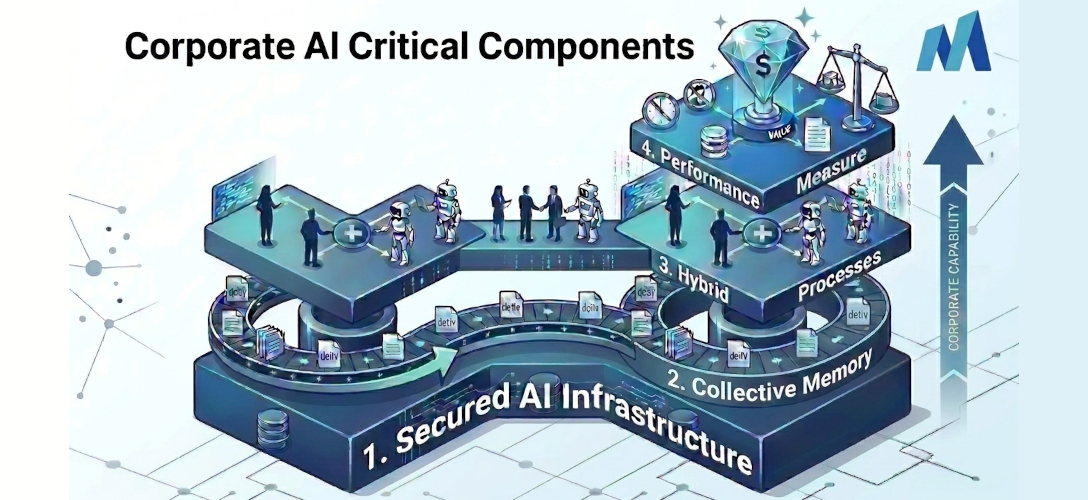
Step 1: Secure the Foundation
Before you deploy any AI Agent that touches client data, you must establish trust through security. This is non-negotiable. A data breach or compliance failure during your launch will destroy the AI narrative before it can take hold.
Begin by auditing your data architecture. Where does the data for your chosen value chain step currently live? Is it in a CRM? An ERP? A document management system? An email server? You need a clear map of data sources, data types, and data flows before you can build an AI Agent that interacts with them safely.
Next, establish governance rules. Define:
- Access controls: Which AI models can access which data? Can the model train on client data, or should it only retrieve and process without retaining?
- Retention policies: How long will data be stored? What happens after a client engagement ends?
- Compliance requirements: Your AI infrastructure must be designed to meet these standards from day one, not retrofitted later.
Security is not a constraint on innovation. It is the foundation that makes innovation possible. Without it, your disruption will be short-lived.
Step 2: Redesign the Value Proposition
Once your infrastructure is secure, you must communicate the change to the market. This is where many companies stumble. They build a powerful AI Agent, then market it as a “new feature” or a “product upgrade.” That is not Radical Innovation. That is incrementalism dressed in new clothes.
You need to reframe the conversation entirely.
Stop talking about features. Start talking about the shift. Your new value proposition is not “faster contract review.” It is “the first law firm to make initial contract review permanently free.” It is not “automated reporting.” It is “the first advisory firm to eliminate the cost of financial reporting for every client.”
This language signals a break from the past. It tells your market that the old pricing model is no longer relevant. It forces competitors to respond on your terms.
Craft your messaging around three pillars:
- The announcement: “We are making [Step X] free, permanently, for every client.”
- The reason: “Because AI allows us to deliver this service at near-zero cost without compromising quality.”
- The implication: “This changes how you should think about working with us. You no longer pay for [Step X]. You only pay for the strategic value that comes after.”
Test this messaging with a small group of trusted clients before going public. Their feedback will help you refine the narrative and identify objections you may not have anticipated.
Step 3: Automate the Low-Value Tasks
Your zero-cost offering must be delivered reliably, consistently, and at scale. This requires more than a chatbot. It requires a well-designed, workflow-based AI Agent that integrates into your existing operations.
Start by defining the end-to-end process for your chosen step. Document every sub-step, every decision point, and every handoff. Then identify which parts of that process can be fully automated and which require human oversight.
For example, if you are offering free contract pre-screening:
- Fully automated: Document ingestion, clause extraction, risk flagging, compliance checking, summary generation.
- Human oversight: Review of flagged clauses, final sign-off on high-risk items, client communication for complex cases.
Design your AI Agent to handle the full automation portion autonomously, with clear escalation paths for the human oversight cases. This ensures quality without sacrificing scale.
Automation is not about replacing humans. It is about freeing your experts to focus on the high-value, strategic work that justifies your premium services—while the AI handles the heavy lifting that makes your zero-cost offering possible.
Step 4: Integrate with Legacy Systems
This is the step that separates successful disruptors from failed experiments. Most AI vendors will tell you to rip out your legacy systems and start fresh. That is not realistic for established companies. You have decades of data, processes, and infrastructure that cannot be replaced overnight.
The right approach is integration, not replacement.
Your AI Agent must connect to your existing CRM, ERP, document management, and communication tools. It must read from your databases, write to your systems of record, and trigger workflows in your existing automation platforms. It must work with your legacy infrastructure, not around it.
This requires careful API design, middleware planning, and data mapping. It also requires a clear understanding of where your legacy systems store the data that your AI Agent needs.
At System in Motion, we help established companies bridge this gap. Our AI platform is designed to integrate with existing enterprise systems, not replace them. We understand that your legacy infrastructure contains years of institutional knowledge. We build AI solutions that surface that knowledge, not silo it.
The companies that will lead the next decade are not the ones with the newest tech stacks. They are the ones with the courage to connect their existing strengths to new AI capabilities—and the strategic clarity to offer something of undeniable value for free.
The Cost of Inaction
Throughout this article, we have laid out a strategy for Radical Innovation. Identify a costly step in your value chain. Use AI to drive its cost to near zero. Give it away for free. Redefine your industry.
It is a compelling vision. But it requires courage. It requires accepting short-term disruption to your own revenue model for long-term market leadership. It requires investing in secure infrastructure, workflow design, and legacy integration before you see the payoff. And it requires moving before you feel ready.
This is where most established companies hesitate. They see the logic. They agree with the analysis. But they delay. They want more data. They want to wait for the technology to mature. They want to see how competitors react first.
Hesitation is the Greatest Risk
Consider the competitive dynamics of your industry. Every company in your space has access to the same AI models. Every competitor is reading the same articles and attending the same conferences. The question is not whether someone will execute this strategy. The question is who will execute it first.
If you wait, one of three things will happen:
-
A competitor will move first. They will identify the same disruption point you identified, or a different one, and they will make it free. Your clients will experience a new standard of value. They will ask you why you are still charging for what your competitor now offers for free. You will be forced to respond from a position of weakness, scrambling to catch up.
-
A new entrant will emerge. Unburdened by legacy systems and existing revenue streams, a startup will build a lean, AI-native offering that targets your most profitable value chain step. They will not need to integrate with legacy infrastructure because they have none. They will move faster, iterate more quickly, and capture market share before you have finished your internal approval process.
-
The market will shift without you. Clients will begin to expect AI-powered, zero-cost services as the baseline. They will no longer accept pricing models built on scarcity. Your current revenue model will erode gradually, then suddenly, and you will have no new model to replace it.
In each scenario, the outcome is the same: you become the disrupted, not the disruptor.
The Another Choice
You can choose to act now. You can run your Rapid Scenario Method this week. You can identify your disruption point, secure your infrastructure, redesign your value proposition, and begin building your AI Agent. You can be the company that redefines what your industry charges for.
This is not blind risk-taking. It is calculated strategic action, supported by the tools and expertise that exist today. The AI models are ready. The integration frameworks are proven. The security standards are established. What remains is leadership..
You do not need a startup mindset to innovate. You need a leader’s mindset. You need the willingness to question what your industry has always accepted, the clarity to see where AI can eliminate cost, and the courage to offer something of undeniable value for free.
The companies that will lead the next decade are not the ones that used AI to save 10% on operations. They are the ones that used AI to change what the industry pays for.
The question is not whether Radical Innovation is possible. It is whether you will be the one to lead it.
Ready to identify your disruption point? Contact us to run your Radical Innovation Workshop . In one hour, we will map your value chain, generate and evaluate multiple disruption models, and leave you with a clear, actionable strategy for leading your industry.
FAQ: Most Common Questions about Radical Innovation
Q1: What is the “Efficiency Trap” and why is it dangerous for established companies? A: The Efficiency Trap is the common but misguided practice of using AI only to automate routine tasks—saving 10–15% on costs or time. It’s dangerous because every competitor does the same, resulting in no competitive advantage. True innovation requires using AI to fundamentally alter your value chain, not just optimize existing processes.
Q2: How does “Radical Innovation” differ from incremental AI improvement? A: Radical Innovation identifies one expensive, slow step in your value chain, uses AI to drive its cost to near zero, then offers that step for free permanently. This redefines the value proposition and forces competitors to respond on your terms, unlike incremental gains that leave market dynamics unchanged.
Q3: What is the “Zero-Cost Value Chain Strategy” and how does it work? A: Every industry has a sequence of activities (value chain) with costs attached. The strategy finds the single link that is costly and painful, then deploys AI to make its delivery nearly free. That step is then given away permanently, creating a new business model around the remaining high-value links—similar to how SaaS made demos free.
Q4: Why does the AI narrative make “free” believable to clients? A: Clients expect AI to reduce costs. When you announce a free service powered by a secure, reliable AI Agent, the reaction is recognition, not skepticism. The AI narrative reframes the offering from “cheap” to “innovative” and signals that the cost savings come from technology, not corner-cutting.
Q5: How does an AI-driven free offering create a competitive moat? A: Competitors cannot copy the free offering without the AI narrative. If they use human labor, they bleed money. If they fake AI, quality fails. Only a company that has invested in secure, reliable AI infrastructure and transparent communication can sustain the model, making imitation costly and risky.
Q6: What is the “Rapid Scenario Method” and how can executives use it to find their disruption point? A: The Rapid Scenario Method is a chain of five AI prompts that map your value chain, identify costly steps to eliminate, propose delivery components, and produce a full business canvas—all in 10–20 minutes. It replaces weeks of consulting with an immediate, actionable framework.
Q7: What are the four steps in the Blueprint for Action described in the article? A: 1) Secure the Foundation – audit data, set governance, ensure compliance. 2) Redesign the Value Proposition – reframe the offering as a permanent free service, not a feature. 3) Automate Low-Value Tasks – design a workflow-based AI Agent for the zero-cost step with clear human oversight. 4) Integrate with Legacy Systems – connect the AI to existing CRM, ERP, and document management without ripping out infrastructure.
Q8: How can a company redesign its value proposition around a zero-cost service? A: Stop marketing the AI offering as a “new feature.” Instead, announce that a specific step (e.g., contract pre-screening) is now permanently free for all clients. Explain that AI makes it possible at near-zero cost without quality loss. The message: “You no longer pay for [Step X]; you only pay for the strategic value that follows.”
Q9: What role does human oversight play in AI automation for Radical Innovation? A: Human oversight is critical for high-risk decisions, complex cases, and final sign-off. The AI Agent handles fully automatable sub-steps (document ingestion, clause extraction, compliance checks) while escalating ambiguous or high-stakes items to experts. This balances scale with quality and trust.
Q10: Why must the AI Agent integrate with legacy systems rather than replace them? A: Established companies have decades of data, processes, and infrastructure that cannot be rebuilt overnight. Integration—via APIs, middleware, and data mapping—allows the AI to read from and write to existing CRM, ERP, and document systems. This preserves institutional knowledge and avoids costly rip-and-replace projects.
Q11: What are the three scenarios if a company hesitates to adopt Radical Innovation? A: 1) A competitor moves first, making your prized step free and forcing you to react from weakness. 2) A new, AI-native entrant captures market share unencumbered by legacy. 3) The market shifts expectations, eroding your revenue model as clients expect zero-cost AI services as the baseline.
Q12: How does the article define a “Zero-Cost Lever” in a value chain? A: It is a single, costly, slow, and taken-for-granted step that AI can reduce to near-zero marginal cost. Examples include product demonstrations for SaaS, contract pre-screening for law firms, or financial reporting for advisory firms. Offering that lever for free permanently changes customer expectations and competitive dynamics.
Q13: What is the psychological advantage of announcing a free AI-powered service? A: Clients already expect AI to lower costs. When you announce a free offering powered by AI, they perceive innovation, not desperation. The “AI narrative” legitimizes the free service, making it a strategic signal of capability rather than a loss leader.
Q14: How does Radical Innovation change the customer’s reference point permanently? A: Once a client receives high-quality service (e.g., contract screening) for free, they will never pay for that step again. The old pricing model becomes obsolete. The disruption is not just technological—it is a shift in perceived value that competitors cannot reverse.
Q15: What immediate action does the article recommend for executives ready to lead? A: Run the Rapid Scenario Method this week to identify your disruption point. Then contact System in Motion for a Radical Innovation Workshop—a one-hour session that maps your value chain, generates disruption models, and delivers a clear actionable strategy. Move before the market moves.
Ready to identify your disruption point? Contact us to run your Radical Innovation Workshop .
We are Here to Empower
At System in Motion, we are on a mission to empower as many knowledge workers as possible. To start or continue your GenAI journey.
Let's start and accelerate your digitalization
One step at a time, we can start your AI journey today, by building the foundation of your future performance.
Book a Training