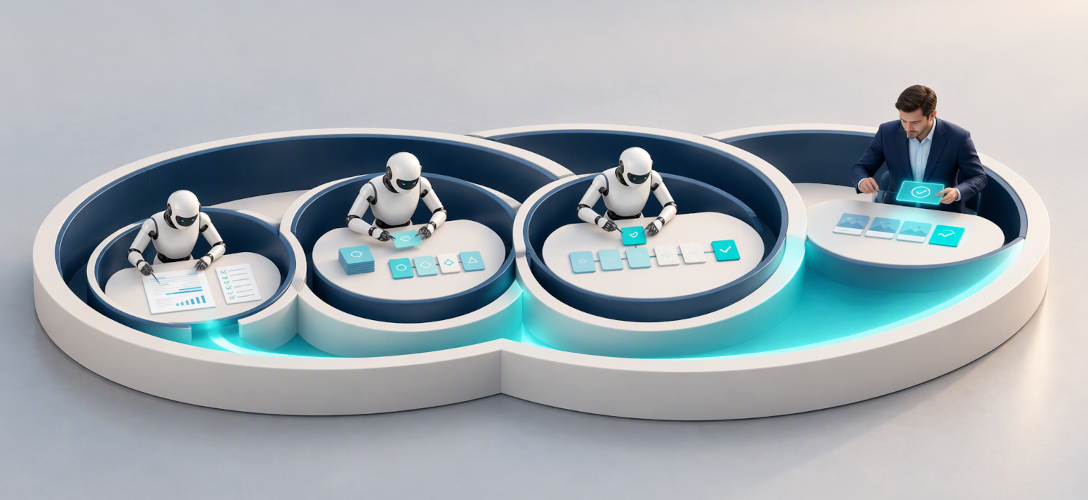
The Regional AI Paradox: Build a Bridge
The Regional AI Paradox: Build a Bridge
The Regional Catch-22
Your leadership team is ambitious. Your competitors are launching AI-driven customer experiences. Your local market is demanding faster, cheaper, smarter operations. And yet, you hear the same four words from Headquarters at every quarterly review: “Wait for global alignment.”
This is the AI paradox. You are caught between a rock and a hard place — or, more precisely, between a cautious, compliance-focused HQ and a breakneck local market that will not wait. If you sit still, your competitors eat your lunch. If you move fast without a strategy, you risk data leaks, rogue pilots, and a trust deficit that takes years to repair.
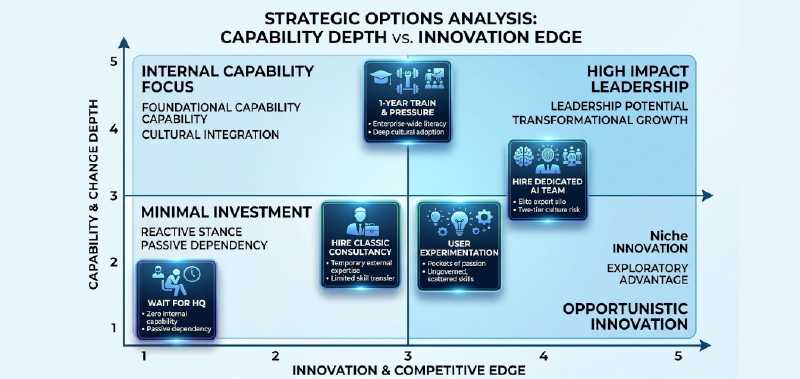
You have five possible approaches on the table. Each looks reasonable at first glance:
- Wait for HQ – Zero internal capability, total dependency, and a ticking clock.
- User Experimentation – Pockets of passion, but ungoverned and scattered.
- Hire a Classic Consultancy – Temporary expertise that leaves when the project ends.
- One-Year Train & Pressure – Enterprise-wide literacy, but a slow, expensive burn.
- Hire a Dedicated AI Team – An elite silo that risks a two-tier culture.
The trouble is, none of these options solve the AI dilemma. The first three leave you dependent or exposed. The last two try to force change from one direction, but they ignore the reality of a regional subsidiary: you need local speed and global alignment. Autonomy and governance. Innovation and trust.
The core truth is this: The answer is not picking one side of the table. It is hybridizing the best elements into a single, coherent strategy.
We call this strategy the Autonomous Bridge.
In the sections that follow, we will examine each pitfall in detail, then lay out the three-phase sprint that transforms your team from a passive cost center into an active, trusted innovation hub — all while keeping your global leadership informed, involved, and impressed.
Let’s begin with what not to do.
The Five Pitfalls: A Critical Analysis of Your Options
Each of the five approaches holds an initial appeal. But when viewed through the lens of a subsidiary, where speed, governance, and capability transfer are non-negotiable, they reveal themselves as traps. Let us examine each one in turn.
Pitfall 1: Passive Dependency — Wait for HQ
The argument for waiting is seductive: align with the mothership, avoid duplication, receive a ready-made playbook. In practice, this creates zero internal capability. Your local team becomes a passive recipient of decisions made 10,000 kilometres away, by people who have never set foot in your market.
The risk is not just delay; it is irrelevance. While you wait, your local competitors are experimenting, learning, and iterating. By the time HQ delivers its global framework, your market has moved on — and you have no muscle memory to catch up.
The verdict: Comfortable, but costly. You become a cost centre, not a revenue driver.
Pitfall 2: Shadow Innovation — User Experimentation
This is the most common pattern we see. A marketing manager discovers ChatGPT and starts generating ad copy. A finance analyst builds an Excel-macro hybrid using a free AI plugin. An operations lead deploys a chatbot on a public cloud instance — without legal review.
These pockets of passion are well-intentioned, but they create ungoverned, scattered skills that expose the entire subsidiary to compliance risk. Sensitive customer data flows through public LLMs. Inconsistent tools create fragmentation. And when HQ eventually audits the region, the response is the same: “We were just experimenting.”
The verdict: Energy without governance. Fun, but dangerous. Data leakage is a matter of when, not if.
Pitfall 3: Temporary Expert — Hire a Classic Consultancy
Engaging a tier-one consultancy feels decisive. You pay for a strategy deck, a roadmap, and a few workshops. The problem is that temporary external expertise rarely transfers to the internal team. On day 90, the consultants leave. You are left with a beautiful PowerPoint and zero operational capability.
Subsidiaries often repeat this cycle quarterly — hiring fresh consultants, re-learning the same lessons, and never building institutional knowledge. It is expensive, repetitive, and ultimately hollow.
The verdict: A Band-Aid, not a cure. You pay for a strategy at best, not a capability.
Pitfall 4: Elite Silos — Hire a Dedicated AI Team
Some regional leaders take the opposite approach: build a dedicated AI team of data scientists and engineers. This creates a two-tier culture risk. The AI team speaks a different language. They work in isolation. They build prototypes that the rest of the business cannot use, maintain, or understand.
Meanwhile, the marketing team keeps doing things the old way. The finance team stays manual. The operations team watches from the sidelines. Innovation becomes the exclusive domain of an expert silo — and transformation never touches the broader organisation.
The verdict: Concentration without diffusion. You build brilliance in a bubble, and the rest of the company stays unchanged.
Pitfall 5: Abrupt Revolution — Train & Pressure for ROI
This approach has the highest potential upside of any on the list — and that is precisely why it is dangerous to get wrong.
Done right, a one-year enterprise-wide training programme, backed by ready-to-use tools and fully supported by a trained management team, is the single most effective engine for deep cultural adoption. When every department — from Marketing to Finance, HR to Operations — understands not just “what AI is” but “what AI does for their function,” and when managers at every level can identify opportunities, govern risk, and drive change, the organisation transforms from within.
This is not a pitfall of intention. It is a pitfall of execution
The trap appears when companies treat the training as a checkbox. They deliver generic modules. They teach theory without immediate application. They train the frontline but skip the executives. And they provide tools without a secure platform to run them.
A trained management team is the linchpin of value creation. If your CFO cannot articulate how AI changes the month-end close, or your Head of Marketing cannot evaluate an AI vendor, or your COO cannot identify which workflows are ripe for automation, then the training has not landed. The culture has not shifted. You have spent a year building vocabulary without building capability.
The second trap is unrealistic pressure
A revolution that demands deep cultural change in twelve months, without staged milestones and visible quick wins, will exhaust the organisation before the new habits form.
The verdict: The most promising path, when executed with density, management participation, immediate tool access, and realistic pacing. But only then. Too little, too late, and this strategy delivers burnout instead of transformation.
When the conditions are met, however, the result is exactly what every subsidiary needs: a literate, empowered, self-sustaining culture that does not depend on external consultants or HQ directives to move forward.
What Else?
Each of these five paths leads to a dead end, some faster than others, but none to the destination you need. The answer is not to pick one. It is to combine the best elements of each into a controlled, high-literacy, fast-execution model that builds local capability while maintaining a transparent link to Headquarters.
That model is the Autonomous Bridge. In the next section, we lay out exactly how it works.
Recommended Strategy: The “Autonomous Bridge”
You have seen the five traps. Now let us talk about the way forward.
The “One-Year Train & Pressure” model, when executed correctly, with tools provided, training across all functions and management levels, and a clear mandate for culture change — is the right ambition. A trained management team is the engine of value creation. A literate organisation is the foundation of sustainable transformation.
The problem is the timeline.
One year is too long. Momentum leaks. Budget cycles shift. Key stakeholders rotate. If, in your market, competitors move in quarters, not years, waiting twelve months for a cultural transformation is a competitive risk you cannot afford.
The Autonomous Bridge is the answer. It delivers the same deep cultural adoption and management-led value creation, but in a focused, three-phase sprint that produces measurable results in six months, not twelve.
Here is how it works.
Phase 1: The AI-Powered Assessment (Day 1)
The traditional approach to AI strategy begins with a lengthy audit: weeks of interviews, spreadsheets, and consultant-led analysis. The result is a report that often confirms what your people already know — but by the time it lands, the context has shifted and the momentum has cooled.
The Autonomous Bridge replaces this with a focused, one-day AI-powered assessment exercise.
Here is the insight that makes it work: nobody knows your business better than your people. Your finance team knows exactly which reconciliation step consumes the most hours. Your HR team knows exactly which employee query repeats most often. Your operations team knows exactly which supplier update creates the most friction. The knowledge is already in the room, it simply needs to be surfaced, structured, and prioritized.
During this day, your teams:
- Map their current workflows in real time, using AI to identify patterns, bottlenecks, and repetition
- Surface low-value, high-volume tasks that are prime candidates for automation
- Flag compliance boundaries and risk areas using an AI-guided governance checklist
- Score and prioritize use cases based on value, risk, and readiness
- Walk away with a ranked shortlist of three to five workflows ready for immediate AI integration
The AI is not analysing your business from the outside. It is amplifying the deep domain expertise of your people, helping them see their own processes with fresh clarity and accelerating their collective judgment.
No generic modules. No wasted time. No waiting weeks for a consultant to tell you what your people already know.
Day one is done. Your customized path forward is clear. Let us build it.
Phase 2: Dense, Functional Training (Day 2–14)
This phase is where the real transformation begins — and where the “Train & Pressure” model succeeds or fails.
Generic AI training is useless. Teaching employees what a large language model is will not change how they work. You need function-specific, role-specific training that answers one question: “How does AI change my job — starting next Monday?”
First your management team, this is the non-negotiable, learns how to identify AI opportunities, evaluate vendor solutions, govern agent behaviour, and lead their teams through the change.
Your finance team learns how AI reconciles accounts, flags anomalies, and accelerates month-end close. Your HR team learns how AI drafts policies, answers employee queries, and screens candidates, all within your existing compliance framework. Your operations team learns how AI agents monitor supply chains, automate status updates, and escalate exceptions.
Without management literacy, the transformation stalls. With it, value creation accelerates exponentially.
Phase 3: Controlled Rollout & Agent Integration (Weeks 1–5)
Training without tools is theatre. This phase closes the loop.
You deploy workflow-based AI Agents that connect directly to your legacy systems, your ERP, your HRIS, your CRM — through a secured, governed platform. These agents are not experimental. They are production-grade, human-supervised, and fully compliant with your regional and HQ policies.
Each agent automates a specific low-value task:
- Finance: Automate invoice matching and exception flagging
- HR: Automate policy retrieval and employee onboarding reminders
- Operations: Automate order status tracking and supplier communication
The agents do not replace your people. They free your people to focus on higher-value analysis, strategy, and judgment, the work that humans do best.
And here is the critical piece for your relationship with HQ: these agents are transparent by design. They log every action, flag every exception, and generate a monthly performance report that demonstrates ROI in the language your global leadership understands.
The Result: The “Autonomous Bridge” in Practice
At the end of seven weeks, your team has achieved what most organisations take eighteen months to build:
- A literate, empowered workforce that understands AI in the context of their function
- A trained management team that identifies and governs AI opportunities
- A dozen live, production-grade AI agents delivering measurable time and cost savings
- A defined governance framework that satisfies both local needs and HQ requirements
- A transparent ROI report that positions your region as a model for the rest of the global organisation
You are not waiting for HQ. You are building the bridge to HQ — demonstrating value, proving governance, and earning the trust that unlocks faster, broader adoption.
You are no longer a cost centre waiting for instructions. You are an innovation hub leading the way.
Building the Bridge: Your First Step
You have read the analysis. You have seen the five traps and the three-phase sprint that avoids them. You understand why the Autonomous Bridge is the superior path for your subsidiary.
Now comes the only question that matters: What do you do on Monday morning?
The answer is simpler than you think. You do not need a six-month planning cycle. You do not need HQ approval for a full transformation programme. You do not need to hire a team of data scientists or engage a tier-one consultancy for a six-figure strategy deck.
You need one day
Share this article with your management team and let them reserve one day in their calendars.
Then contact us for a 30-minute discovery call. We will listen to your situation, answer your questions, and help you determine whether the Autonomous Bridge is the right fit for your organisation. If it is, we will schedule your AI-Powered Assessment day. If it is not, we will tell you honestly and point you toward resources that can help.
Either way, you will leave the conversation with more clarity than you had when you arrived.
FAQ: The Autonomous Bridge Strategy
Q1: What is the central challenge for subsidiaries adopting AI? A: The central challenge is the tension between local speed and global governance. Subsidiaries operate in fast-moving markets where competitors are already deploying AI, yet they must answer to a Headquarters that prioritizes compliance, risk management, and global alignment. Waiting for HQ creates irrelevance. Moving without governance creates exposure. The solution is not choosing one side but hybridizing speed and safety into a single strategy.
Q2: What are the five common AI strategy approaches for subsidiaries, and why do they fail? A: The five approaches are:
- Wait for HQ – Creates zero internal capability and passive dependency.
- User Experimentation – Ungoverned, scattered skills that risk data leakage.
- Hire a Classic Consultancy – Temporary expertise that leaves with no skill transfer.
- One-Year Train & Pressure – High potential, but slow execution risks momentum loss.
- Hire a Dedicated AI Team – Elite silos that create a two-tier culture.
Each fails because it addresses only one dimension of the problem—speed, governance, or capability—rather than all three simultaneously.
Q3: What is the Autonomous Bridge strategy? A: The Autonomous Bridge is a three-phase, seven-week sprint that delivers deep AI literacy, management-led governance, and production-grade AI agents in a fraction of the time traditional approaches require. It combines the best elements of the five common approaches: the ambition of enterprise-wide training, the speed of user experimentation, the security of HQ-aligned governance, and the expertise of dedicated teams—without their respective downsides.
Q4: How does the AI-Powered Assessment work, and why is it only one day? A: The AI-Powered Assessment is a single, intensive working session where functional leaders and key stakeholders map workflows, surface bottlenecks, and prioritize use cases using AI-powered facilitation tools. It works in one day because the deep business knowledge is already in the room. The AI does not analyse from the outside; it amplifies the collective expertise of your people to surface patterns, flag risks, and rank opportunities in real time. The output is a customized training blueprint and a ranked shortlist of three to five workflows ready for automation.
Q5: Why is management training the non-negotiable element of AI transformation? A: Management training is the linchpin of value creation because managers are the ones who identify opportunities, evaluate solutions, govern agent behaviour, and lead teams through change. If your CFO cannot articulate how AI changes month-end close, or your COO cannot identify workflows ripe for automation, the transformation stalls. Without management literacy, AI remains a tactical experiment. With it, every department becomes a self-sustaining source of AI-driven improvement.
Q6: How does the Autonomous Bridge ensure compliance and satisfy Headquarters governance requirements? A: Compliance is built into every phase of the Autonomous Bridge. The AI-Powered Assessment includes an AI-guided governance checklist that flags risk areas and compliance boundaries before any training or deployment begins. Phase 3 deploys agents on a secured, governed platform that logs every action, flags every exception, and generates transparent ROI reports. This ensures that local speed never compromises global governance, and HQ receives the visibility and control it requires.
Q7: How long does the full Autonomous Bridge programme take? A: The full programme runs for seven weeks:
- Day 1: AI-Powered Assessment
- Days 2–14: Dense, functional training for management and all departments
- Weeks 1–5: Controlled rollout and integration of production-grade AI agents
This is a fraction of the twelve months required by traditional “Train & Pressure” approaches, and it delivers measurable, governable results in a single quarter.
Q8: What types of AI agents are deployed during Phase 3? A: Phase 3 deploys workflow-based AI agents that automate specific, low-value, high-volume tasks. Examples include:
- Finance: Invoice matching and exception flagging
- HR: Policy retrieval and employee onboarding reminders
- Operations: Order status tracking and supplier communication
These agents connect directly to legacy systems (ERP, HRIS, CRM) through a secured, governed platform. They are production-grade, human-supervised, and fully compliant with local and HQ policies.
Q9: How does the Autonomous Bridge avoid the “two-tier culture” risk of dedicated AI teams? A: The Autonomous Bridge avoids elite silos by building AI literacy across the entire organisation before any agents are deployed. Everyone—from finance analysts to operations leads to senior managers—learns how AI applies to their specific function. When agents are deployed, they are understood, governed, and maintained by the people who use them, not by a separate data science team. This prevents the concentration of expertise in a bubble and ensures transformation reaches every department.
Q10: What measurable outcomes can a subsidiary expect after seven weeks? A: After seven weeks, a subsidiary can expect:
- A literate, empowered workforce that understands AI in the context of their function
- A trained management team that identifies and governs AI opportunities
- Multiple live, production-grade AI agents delivering measurable time and cost savings
- A defined governance framework that satisfies both local and HQ requirements
- A transparent ROI report that positions the region as a model for the global organisation
Q11: How does the Autonomous Bridge differ from hiring a classic consultancy? A: A classic consultancy delivers a strategy deck and leaves. The Autonomous Bridge delivers a living capability. The AI-Powered Assessment produces a customized training blueprint, not a static report. The training builds internal literacy and management ownership, not passive dependency. The agents are deployed on a platform the subsidiary owns and operates. When the seven weeks are complete, the organisation has the skills, governance, and infrastructure to continue evolving without external hand-holding.
Q12: Is the Autonomous Bridge suitable for any industry or market? A: Yes. The methodology is industry-agnostic because it is built on a universal principle: your people already know where AI creates value in your specific business. The AI-Powered Assessment surfaces that knowledge regardless of whether you are in manufacturing, financial services, healthcare, retail, or logistics. The compliance framework adapts to your regulatory environment. The agents integrate with your existing legacy systems. The result is a tailored solution, not a one-size-fits-all template.
Q13: How do we maintain momentum after the seven-week programme ends? A: The Autonomous Bridge is designed for self-sustainability. Your management team is trained to identify new opportunities. Your workforce is literate in AI application. Your governance framework is established. Your platform is operational. After the programme, your subsidiary has the internal capability to identify, prioritize, and deploy new agents independently. System in Motion remains available for advanced training, new use case discovery, and platform scaling, but the dependency is optional, not structural.
Q14: Why should a subsidiary act now rather than wait for HQ alignment? A: Because the market will not wait. Every quarter a subsidiary delays is a quarter competitors use to learn, iterate, and pull ahead. Every quarter spent debating options is a quarter employees spend building shadow AI in ungoverned corners of the business. The Autonomous Bridge proves value, demonstrates governance, and earns trust in seven weeks—positioning the subsidiary as an innovation hub that leads the global organisation, rather than a cost centre that waits for instructions.
Q15: How do we get started, and what is the first step? A: The first step is a 30-minute discovery call with System in Motion. No pitch, no pressure. We listen to your situation, answer your questions, and help you determine whether the Autonomous Bridge is the right fit. If it is, we schedule the AI-Powered Assessment day. If it is not, we tell you honestly and point you toward resources that can help. Either way, you leave with more clarity than you had when you arrived.
We are Here to Empower
At System in Motion, we are on a mission to empower as many knowledge workers as possible. To start or continue your GenAI journey.
Let's start and accelerate your digitalization
One step at a time, we can start your AI journey today, by building the foundation of your future performance.
Book a Training