
Powerful AI Makes Lazy Users Expensive

Powerful AI Makes Lazy Users Expensive
The Great Deception of “Easy AI”
Imagine walking into a car dealership. The salesperson points to a gleaming, high-performance sports car and says, “This car is so advanced, you don’t even need to know how to drive. Just get in, mumble where you want to go, and it will figure out the rest.”
Sounds incredible, right? Until you get the bill for the fuel, the maintenance, and the countless detours the car took because you couldn’t be bothered to give clear directions.
This is exactly what is happening with the latest generation of AI agents.
The AI industry is selling us a beautiful dream: “Type a vague sentence, and our super-agent will handle the rest. No training needed. No skill required. Just pure, effortless power.” And for the user, it feels like magic. You ask for “a report on sales,” and the agent spends minutes searching databases, writing drafts, calling APIs, and generating a lengthy document. It works. It’s impressive.
But here’s the paradox: this convenience is a trap.
The more powerful these models become, the more expensive they are to run. Every extra step the agent takes to interpret your vague request costs tokens—or the new, even pricier “credits” that represent agent work. The industry has realized something crucial: user dependency equals recurring revenue. The vaguer your prompt, the longer the agent works, the more they charge.
This is not the quest for AGI anymore. That was the old marketing story. The new reality is a business model built on lazy users.
And so we arrive at a strange twist in the AI story. The industry is pushing us to be lazier, while at the same time, companies are waking up to shocking monthly bills—millions of tokens burned on tasks that could have been done in a fraction of the time and cost, if only the user had given a clear, concise prompt.
The question is no longer, “How smart can AI get?” The question is, “How much will you pay for your own laziness?”
In this post, we’ll pull back the curtain on this economic shift, reveal why the value of AI training has just multiplied tenfold, and show you how to stop burning money on “easy” AI.
II. The Economic Shift: From AGI to the “Credit Starvation” Model
To understand why your AI bills are spiraling, you have to understand the narrative shift that happened behind closed doors in the AI industry.
The Old Story: The Quest for AGI
For years, the industry sold us a beautiful vision. The goal was Artificial General Intelligence, a machine so smart it could think, reason, and act like a human. Every new model was marketed as a step closer to this holy grail. “Make the model smarter, and users will achieve more,” they said. It was a story about capability.
And we believed it. We invested in training, we learned to craft precise prompts, and we celebrated every incremental improvement in model performance.
The New Story: The Quest for Dependency
But somewhere along the way, the story changed. The industry realized something that changed the entire game:
The smarter the model, the more you depend on it. The more you depend on it, the more you use it. The more you use it, the more you pay.
AGI was never the finish line. Recurring revenue was.
So the industry pivoted. Instead of building models that required skill to use (which limited their market), they built models that required no skill at all. They designed systems that could interpret vague, lazy prompts and still produce impressive results. This wasn’t just a feature—it was a business strategy.
The Mechanics of the Trap
Here is how the trap works in practice. It’s elegant, and it’s expensive.
Step 1: The Vague Prompt
You type: “Analyze our Q3 sales data and give me insights.”
Step 2: The Agent’s Dilemma
The AI doesn’t know what you really want. “Which data? What region? What metrics? How should I present this?” So it takes matters into its own hands.
Step 3: The Token Explosion
The agent starts an internal loop:
- It looks for information about the company (token spent).
- It looks for sales analysis reports (token spent).
- It searches for the data (tokens spent + tools used).
- It guesses the format (tokens spent).
- It drafts a report (tokens spent).
- It second-guesses itself and rewrites (tokens spent).
- It calls external tools to verify (more tokens spent).
- It looks for mistakes (more tokens spent).
- It always finds mistakes and fixes them (more token spent).
- It generates a summary (even more tokens spent).
What a skilled user could achieve in a few minutes at low cost, with a clear, structured prompt, a lazy user triggers a 30-minute, expensive process with a vague one.
The “Credit” System: The Next Frontier
And now, the industry has introduced something even more insidious: credits.
Credits are not the same as tokens. Tokens are the raw currency of text generation. Credits represent agent work, the orchestration, the tool calls, the decision loops, the multi-step reasoning. And credits? They are significantly more expensive than tokens.
Why? Because the industry realized that if they could get you to pay for the process rather than just the output, they could multiply their revenue overnight.
A simple task that used to cost a few cents in a standard model now costs several dollars in an agent-powered model, simply because the user couldn’t be bothered to write a clear prompt.
The Result: A Perfect Revenue Model
Look at it from the industry’s perspective. It’s genius:
- Lazy users = Long processes.
- Long processes = More tokens.
- More tokens = More revenue.
- No training required = No barriers to adoption.
The industry has absolutely no incentive to educate users. In fact, they have every incentive to keep them ignorant. An educated user who writes a precise, 50-word prompt and gets an answer in three seconds costs them almost nothing. An uneducated user who types “do this thing vaguely” and lets the agent wander for three minutes is their most profitable customer.
This is why we are seeing a wave of “shock bills” hitting companies. They roll out the new agent features, their employees type vague requests like they always have, and suddenly the monthly AI spend has multiplied by 10x—or 100x.
The trap is set. The bait is convenience. And too many companies are biting.
III. The “Shock Bill” Crisis: Why Companies Are Bleeding Money
The trap described in the previous section is not theoretical. It is playing out right now in boardrooms and finance departments across the globe. And the stories are starting to sound eerily similar.
The Scene: A “Simple” Rollout
Picture this. A mid-sized company decides to embrace the future. They purchase a subscription to a cutting-edge AI platform featuring the latest agent technology. The CEO is thrilled. The IT team rolls it out to the entire organization with a cheerful email:
“We are excited to announce that our new AI agent is now available to all employees. Just type what you need, and it will handle the rest. No training required!”
No training required. Those three words are the beginning of the crisis.
The Problem: The Vagueness Epidemic
Employees, already overwhelmed with work, embrace the tool eagerly. They type prompts like:
- “Help me write a proposal for a new client.”
- “Summarize our Q4 performance and suggest improvements.”
- “Create a marketing plan for next quarter.”
- “Analyze our customer feedback and tell me what’s wrong.”
Each of these prompts is a grenade with the pin pulled.
The agent, designed to be helpful, does exactly what it was built to do: it goes to work. It searches for context. It makes assumptions. It calls external tools. It drafts, revises, double-checks, and generates.
For every single prompt, the token count explodes. The credit meter spins.
And no one notices. Because the magic is happening. The output looks great. The agent seems brilliant.
The Outcome: The Shock Bill
Then comes the end of the month.
The finance department opens the invoice and their jaws hit the floor.
- Expected monthly spend: $50,000.
- Actual monthly spend: $850,000.
Panic ensues. The CFO demands an explanation. The IT team scrambles to investigate. They dig into the logs and discover the ugly truth:
Hundreds of employees typing vague prompts. Each prompt costing 10x to 50x more than it should. A single “help me write a proposal” request burning through thousands of tokens as the agent fumbled through unnecessary steps.
The company has just learned an expensive lesson: convenience has a price, and they just paid it.
The “Cap” Move: A Band-Aid on a Bullet Wound
In response to the shock, leadership does what seems logical: they set a hard limit.
“We are implementing a monthly cap of $100,000 on AI usage. Once the cap is reached, the tools will be unavailable for the remainder of the month.”
Problem solved? Not even close.
Here is what happens next:
- Day 1–5: The heavy users burn through the cap quickly, writing vague prompts without any awareness of cost.
- Day 6–10: The cap is already 80% consumed. IT starts getting frantic emails: “Why is the AI slow? Why did it stop working?”
- Day 11: The cap is hit. All AI tools are frozen for the rest of the month.
The Irony: Powerful AI Becomes Useless AI
Now the company is in an absurd situation:
- They are paying $100,000 a month for a tool.
- That tool is available for only 10 days out of 30.
- For the remaining 20 days, employees are locked out.
- Productivity drops. Frustration rises. The tool that was supposed to empower everyone has become a source of resentment.
And here is the cruelest irony: the $100,000 they are spending could have lasted the entire month, with change to spare, if users had simply been trained to write clear, concise prompts.
They are paying a premium for laziness and getting locked out as a reward.
The Pattern Is Spreading
This is not an isolated incident. Across industries, we are seeing the same pattern emerge:
| Scenario | Result |
|---|---|
| Company A launches agent to 500 employees | $1,200,000 bill in first month. Immediate freeze. |
| Company B sets a cap at $500,000 | Tools locked by the 12th of the month. Employee revolt. |
| Company C does not know how to set-up the cap | Bill doubles every month. Leadership panics. |
| Company D provides no training | Vague prompts dominate. Cost per task is 50x higher than necessary. |
| Company E does not implement AI Agents | Top performers leave for the competition. |
The crisis is real. It is happening now. And it is only going to get worse as AI agents become more powerful, more autonomous, and more expensive.
But there is a solution. And it does not require turning off the AI or locking out your employees. It requires something far simpler: education.
IV. The 10x Value of AI Training
If you have made it this far, you might be feeling a mix of emotions. Alarm, perhaps, if you are staring at your own company’s AI bills. Frustration, if you have been on the receiving end of a sudden tool freeze. Or maybe even a flicker of recognition, because you have seen this play out firsthand.
But here is the good news. The crisis is not inevitable. And the solution is not to abandon AI. It is to rethink training.
The Great Revaluation
Two years ago, AI training had a very specific purpose: getting results from a weak model. Back then, models were limited. They struggled with context. They needed careful hand-holding to produce anything useful. Training was about coaxing performance out of an unreliable tool.
That world has shifted.
Today, agents and models are powerful. They can handle vague prompts. They can figure things out on their own. But that power comes at a cost. And the AI industry has designed the economics so that the lack of training is the most profitable scenario for them.
So here is the shift that has happened in the last two months:
The value of AI training has multiplied by 10x.
Not because the models got weaker. But because the cost of not knowing how to use them got exponentially higher.
The “Simple Model” Strategy
Let me introduce you to a concept that will save your company thousands, if not millions, of dollars: the simple model strategy.
Here is how it works:
A skilled user receives a complex request. They could type it into the powerful agent and let it figure everything out, burning tokens and credits along the way. Instead, they stop. They think. They break the request down into its simplest components.
Then they take those components to a smaller, cheaper model.
A model like GPT-4o-mini, Caude Haiku, or DeepSeek V4 Flash. Or a fine-tuned open-source model that costs pennies per million tokens.
They write a clear, specific, structured prompt. The kind of prompt that takes 30 seconds to craft because the user knows exactly what they need.
The result?
- Time: The simple model responds in seconds. The agent might take minutes.
- Cost: The simple model costs pennies. The agent costs dollars.
- Quality: The simple model gives exactly what was asked for. The agent might wander into irrelevant territory.
Why This Is a Win-Win
This is not about depriving users of powerful tools. It is about using the right tool for the right job.
| Task Type | Recommended Model | Why |
|---|---|---|
| Complex multi-step research, analysis, planning | Large model or agent | Worth the cost for complex tasks |
| Creative writing, brainstorming, strategy | Medium model | Good balance of quality and cost |
| Routine tasks, templates, emails | Small model | No need for agent-level intelligence |
| Simple Q&A, summarization, data extraction | Small, cheap model | Fast, cheap, precise |
When a user can do 80% of their work with a simple model and leave the expensive agent for the remaining 20% that truly requires it, the economics transform.
- The company saves money. Bills become predictable. The cap is never hit.
- The user saves time. No waiting for an agent to think through a simple request. Results come back instantly.
- The AI budget lasts. The expensive tool is available all month, for everyone, because it is not being wasted on trivial tasks.
The Hidden Benefit: Time
But there is another benefit that is harder to quantify but equally valuable: time.
When a user writes a vague prompt for an agent, they wait. The agent thinks. It searches. It generates. It revises. The user stares at a spinning cursor, context-switches to another task, and loses focus.
When a user writes a clear prompt for a simple model, the answer comes back instantly. The user stays in flow. They complete their work faster. They move on to the next task.
The simple model strategy is not just about saving money. It is about saving attention. And in a world where attention is the scarcest resource of all, that might be the most valuable benefit of all.
The Shift in the Industry
This is why we are seeing a quiet shift in the last two months. Smart companies are starting to realize that the “powerful agent for everyone” model is a financial trap. They are pulling back. They are investing in training. They are implementing tiered access models where expensive tools are reserved for specific use cases.
And the AI training industry? It is booming.
Because the companies that survive the AI cost crisis will not be the ones with the biggest models. They will be the ones with the most skilled users.
The ones who can do more with less. Who can get the same results for a fraction of the cost. Who understand that the most powerful AI is not the one that does the most thinking for you, but the one that does the right amount of thinking for the right price.
And that is a skill worth training for.
V. How System in Motion Stops the Bleed
The “simple model strategy” I described above is powerful in theory. But in practice, implementing it across an established, multi-department MNC is where most efforts fail. You cannot just tell employees to “write better prompts” and expect the cost crisis to vanish.
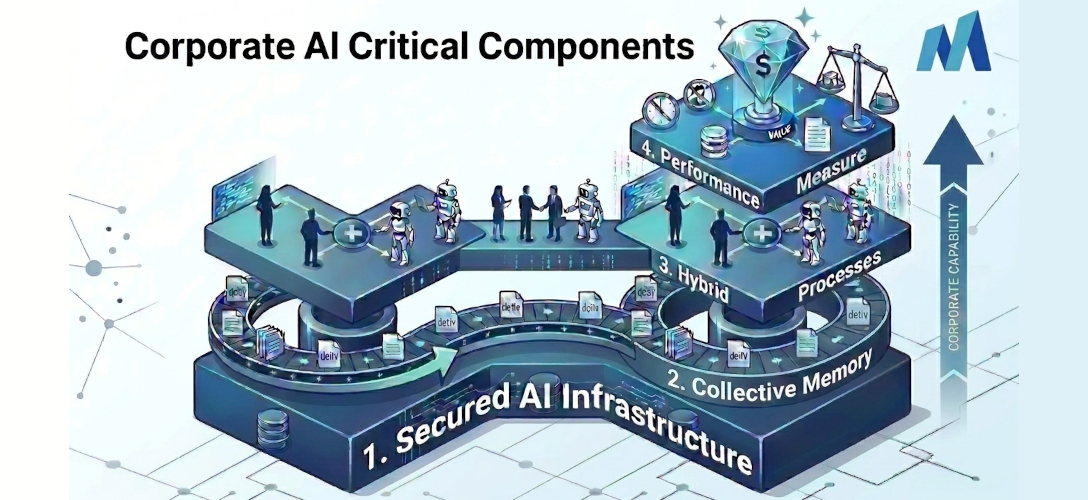
That is why we built System in Motion around three structural pillars—each designed to turn the economic trap of powerful AI into a competitive advantage for your company.
Pillar 1: Functional AI Specialization – Training That Matches the Work
Generic AI training teaches people how to talk to a chatbot. It does not teach a finance controller how to reconcile thousands of line items with a small model in 12 seconds. It does not teach a marketing director how to generate 50 regional variants of a campaign brief without burning an entire month’s agent budget.
We deliver dense, task-specific training for each function—Finance, Marketing, HR, Operations, Legal. Your teams learn:
- Which model (small, medium, agent) to use for each specific task.
- How to craft structured prompts that return results in a single call, not a multi-step agent loop.
- How to build reusable templates that turn complex analysis into a 3-second, low-cost operation.
The result: the same output, at 10–20x lower cost, with zero waiting time.
Pillar 2: Secure Agent Deployment – Guardrails, Not Handcuffs
Powerful AI agents are not the enemy. The enemy is deploying them without cost controls and behavioral boundaries.
We deploy your agents inside a secured infrastructure that enforces three rules automatically:
- Cost ceilings per task: The agent cannot spend more than a defined token/credit limit on any single request.
- Model routing: A simple request is automatically sent to a cheap, fast model. Only complex, multi-step tasks reach the expensive agent.
- Audit logs for leadership: Every prompt, every model call, every cost is logged. You see exactly who is burning budget and where.
This is not about locking down your employees. It is about giving them the freedom to use powerful tools without creating surprise bills.
Pillar 3: Legacy Integration – AI That Works With What You Already Own
Shock bills often come from agents that try to “figure out” your company’s data from scratch—calling random APIs, searching public databases, making guesses about your ERP or CRM structure.
We integrate our agents and models directly into your existing systems: SAP, Oracle, Salesforce, custom databases, HRIS platforms. The agent knows where the data lives and how to access it securely, without wasteful searching.
- A request like “Summarize Q4 APAC sales” does not trigger a 5-minute agent exploration. It triggers a structured query against your actual database, returning the answer in seconds.
- The cost? Pennies, not dollars.
By connecting AI to your real infrastructure, we eliminate the two biggest cost drivers: context guessing and tool misuse.
The Bottom Line
The 10x value of training is real. But it is only unlocked when training is paired with functional specialization, secure deployment, and legacy integration.
System in Motion delivers all three. We do not just teach your people to be better AI users. We give them the infrastructure, the guardrails, and the integration that make that skill actually save you millions.
The industry is betting on your ignorance. We are betting on your mastery.
VI. The User Is the Ultimate Cost Controller
We have traced the arc of this story from the rise of powerful agents, through the shock bills, to the rediscovery of training as a cost-saving superpower. Now it is time to land the plane.
The Myth We Must Debunk
There is a pervasive myth circulating in the AI industry today. It goes something like this:
“Users don’t need to be educated anymore. The models are smart enough to understand anything you throw at them. Just type naturally and let the AI handle the rest.”
This myth is not just wrong. It is dangerous.
It is a myth sold by companies that profit from your ignorance. Every vague prompt you type is a small donation to their bottom line. Every minute an agent spends wandering through irrelevant steps is a microtransaction flowing into their revenue stream.
The industry has designed a system where the laziest users are the most profitable customers. And they are marketing that laziness as “progress.”
The Truth We Must Embrace
The truth is simpler and more empowering:
The user is the ultimate cost controller.
No algorithm, no pricing model, no IT policy can match the impact of a single user who knows what they are doing. A skilled user can:
- Get the same result for 10x less cost.
- Complete the task in seconds instead of minutes.
- Keep the expensive tools available for the entire month.
- Free up budget for the truly complex tasks that need the power.
This is not about restricting access. It is about maximizing value. Every dollar saved on a lazy prompt is a dollar that can be spent on a high-value, high-complexity task that truly requires an agent’s capabilities.
The Call to Action
So here is what I am asking you to do.
If you are a user:
- Learn to write clear, specific prompts.
- Choose the smallest model that can do the job.
- Treat every token like it comes out of your own pocket.
If you are a leader:
- Invest in training, not just tools.
- Audit your usage and identify the cost drivers.
- Build a culture that rewards efficiency, not just convenience.
If you are a vendor:
- Be honest with your customers about the true cost of lazy prompting.
- Build features that encourage efficient usage, not dependency.
- Remember that the most sustainable relationship is built on empowered users, not trapped ones.
The Final Word
The most powerful AI is not the one that does the most thinking for you. It is the one that does the right amount of thinking for the right price.
And that distinction can only be made by a skilled, educated, cost-conscious user.
Two years ago, AI training was about getting results from weak models. Today, it is about saving money on powerful ones. And the value of that skill has never been higher.
The industry will keep pushing toward dependency. The models will keep getting smarter. The pricing will keep getting more complex.
But the user who knows how to prompt clearly, choose the right model, and control their costs will always have the upper hand.
Because in the end, the AI is just a tool. The real power has always been in the hands of the person using it.
Master AI to Optimize Your Budget While Reducing Risk
Talk directly to our AI Strategist. In a 30-minute call, we will map your current AI stack, identify the biggest cost risks, and outline a tailored three-pillar plan (training, secure deployment, legacy integration) for your company.
Frequently Asked Questions
Q1: Why are my company’s AI bills suddenly exploding, even though usage seems normal? A: The explosion is caused by a shift from simple, cost-per-token models to powerful AI agents that charge for “work” (credits) rather than just output. When users type vague prompts (e.g., “analyze sales data”), the agent initiates a multi-step loop—searching, guessing, drafting, revising—that burns 10–50x more tokens than a clear, structured prompt. The industry profits from this dependency, as lazy users become the most expensive customers.
Q2: What is the “credit system” and how is it different from tokens? A: Tokens are the raw currency of text generation (e.g., a few cents per thousand). Credits represent agent work—orchestration, tool calls, decision loops, and multi-step reasoning. Credits are significantly more expensive than tokens because they price the process, not just the output. A task that costs pennies in a standard model can cost several dollars in an agent model, simply because the user’s vagueness triggers unnecessary steps.
Q3: Should I set a hard monthly cap on AI usage to control costs? A: A hard cap is a band-aid, not a solution. It leads to the “cap crisis”: heavy users burn through the budget in the first 10 days, tools freeze for the rest of the month, productivity drops, and employee frustration rises. The same budget could last the entire month—with change to spare—if users were trained to write clear, concise prompts and use cheaper models for routine tasks.
Q4: Is AI training still necessary now that models are so powerful? A: Yes, and its value has multiplied 10x. Two years ago, training was needed to get results from weak models. Today, training is needed to control costs from powerful models. An educated user who writes a precise 50-word prompt and chooses the right model costs pennies. An uneducated user who types “do this vaguely” can burn dollars per request. Training is now a direct cost-saving lever, not a nice-to-have.
Q5: What is the “simple model strategy” and how does it save money? A: The simple model strategy means breaking a complex request into its simplest components and routing them to a smaller, cheaper model (e.g., GPT-4o-mini, Claude Haiku, DeepSeek V4 Flash). These models cost pennies per million tokens, respond in seconds, and deliver exactly what was asked. The expensive agent is reserved for the 20% of tasks that genuinely require multi-step reasoning. Result: 80% of work at 10–20x lower cost.
Q6: How do I choose between a small, medium, or large model for a given task? A: Use a simple tiered framework: (1) Small model for routine tasks—templates, emails, Q&A, summarization, data extraction. (2) Medium model for creative writing, brainstorming, strategy—good balance of quality and cost. (3) Large model or agent only for complex multi-step research, analysis, or planning that truly requires autonomy. The skilled user selects the smallest model that can do the job, cutting costs immediately.
Q7: What is the “shock bill” crisis and how can I avoid it? A: The shock bill crisis occurs when a company rolls out a powerful AI agent to all employees without training. Users type vague prompts, the agent burns through tokens and credits, and the monthly bill multiplies by 10–100x. To avoid it: invest in functional training, enforce cost ceilings per task, implement model routing (cheap models for simple queries), and audit usage logs monthly.
Q8: Why does the AI industry not want to educate users? A: Because user dependency equals recurring revenue. The industry has designed a business model where the laziest users are the most profitable. Every vague prompt and every unnecessary agent loop generates more token and credit consumption. Educated users who write precise prompts and use cheap models cost the vendor almost nothing. Thus, vendors have a financial incentive to keep users ignorant.
Q9: How do I integrate AI agents with my existing legacy systems (SAP, Oracle, Salesforce) without burning budget? A: Direct integration eliminates the cost of “context guessing.” Instead of the agent searching public databases or making API calls to find your data, you connect it directly to your ERP, CRM, and HRIS. The agent knows exactly where the data lives and how to query it securely. A request like “Summarize Q4 APAC sales” becomes a structured query returning results in seconds for pennies, not a five-minute exploratory loop.
Q10: What is the ROI of investing in AI training for my employees? A: The ROI is dramatic: a trained user can achieve the same output for 10–20x less cost, complete tasks in seconds instead of minutes, and keep expensive tools available all month. The alternative—no training—leads to shock bills, capped usage, and employee lockouts. Training also improves attention and flow, as users don’t wait for agents to wander through irrelevant steps. The cost of training is quickly recouped in saved token spend.
Q11: How can I implement cost controls without restricting employee productivity? A: Use three measures: (1) Cost ceilings per task—set a maximum token/credit limit for any single request. (2) Model routing—automatically send simple requests to cheap, fast models; only escalate complex tasks to expensive agents. (3) Audit logs—show leadership exactly who is burning budget and where. These controls give employees freedom to use powerful tools while preventing surprise bills.
Q12: What is the difference between a “vague prompt” and a “precise prompt” in terms of cost? A: A vague prompt (e.g., “Help me write a proposal” ) triggers a multi-step agent loop: searching for context, guessing the format, drafting, revising, double-checking—burning thousands of tokens. A precise prompt (e.g., “Write a 3-page proposal for Client X, focusing on cost savings, using our standard template, with bullet points for benefits” ) returns the answer in a single call to a small model, costing pennies. The cost difference is often 10–50x.
Q13: Should I let all employees use the same powerful AI agent, or limit access? A: Limit access to the most powerful agent to the 20% of tasks that genuinely need it. For the other 80% of tasks, provide access to smaller, cheaper models. This is the “tiered access” model. It prevents the expensive agent from being wasted on routine work and ensures the budget lasts all month. Training employees to choose the right tool for the job is essential to make this work.
Q14: How do I audit my company’s AI usage to find cost leaks? A: Review audit logs that show for each request: the prompt text, the model used, the token/credit consumption, and the time taken. Look for patterns: repetitive vague prompts, frequent use of the expensive agent for simple tasks, and high-cost users. Then provide targeted training to those users and implement model routing rules to automatically redirect routine queries to cheaper models.
Q15: What is the “quest for dependency” and how does it affect my strategy? A: The “quest for dependency” is the shift from the old goal of AGI (making models smarter) to a new business model where vendors profit from making users dependent on their systems. They design agents to work with vague prompts, encouraging laziness, and price the process (credits) rather than the output. Your strategy must counter this by investing in user education, model selectivity, and cost controls—turning your employees into skilled cost controllers, not passive consumers.
Talk directly to our AI Strategist. In a 30-minute call, we will map your current AI stack, identify the biggest cost risks, and outline a tailored three-pillar plan (training, secure deployment, legacy integration) for your company.
We are Here to Empower
At System in Motion, we are on a mission to empower as many knowledge workers as possible. To start or continue your GenAI journey.
Let's start and accelerate your digitalization
One step at a time, we can start your AI journey today, by building the foundation of your future performance.
Book a Training